
The Correct Rajma Chawal
On the First Time the World Felt Wrong

I remember rain.
Not a storm exactly, only the soft insistence of rain somewhere beyond the windows.
I remember waking on my own. The room glowed a dim pastel green in the night light and I could sense movement in the house. Doors opening. Hushed voices. The peculiar urgency that adults mistake for quiet.
I did not understand any of it.
I remember standing in the bedroom doorway and seeing a world that suddenly felt unfamiliar.
Someone was crying.
Someone was making phone calls.
Someone kept saying that the children should sleep.
But I could not see my mummy amongst them.
The next morning the house felt strange.
Not empty exactly.
Just wrong.
Relatives appeared in rooms where I did not expect them. Adults spoke in lowered voices. Every answer seemed to arrive wrapped in another question.
“Where is mummy?”
“She’s away.”
“When is she coming back?”
“Soon.”
I must have asked a dozen times.
Each answer felt as though it had been carefully chosen to end the conversation, yet none of them settled anything inside me. They hovered in the air, incomplete, as though something essential had been left unsaid.
Children have a remarkable faith in doors. I kept expecting one of them to open and for my mummy simply to walk through.
But no door opened.
Instead, someone placed a steel bowl of rajma chawal in front of me.
“Please eat,” my sister-in-law pleaded gently.
I could not.
I almost didn’t recognise what was in front of me. The rajma sat scattered across the rice, too much tarri pooling around it. It looked unfamiliar, as though it belonged on someone else’s plate.
Tears rolled down my face.
She urged me to have just one bite.
Tears gushed harder.
I do not know whether it was prepared differently or whether something inside me had changed, only that it felt wrong.
Then the front door opened.
Daddy was home.
As the youngest, I shared a quiet, unquestioned closeness with my father. Ours was a relationship of songs and laughter, hugs and kisses, and his remarkable ability to restore my temperamental little world with silliness and affection.
But that day he looked worn out.
Not the sort of fatigue that sleep remedies.
He looked worn in a way I had never seen before.
He lifted me into his arms and held me for a long while.
Then he insisted that I eat, telling me it would make my mummy feel better knowing I had eaten.
I swallowed those few bites with a strange kind of hope, as though his words carried the power to make things right again.
Children are wonderfully transactional with the universe.
If I eat, mummy will come home.
If I am brave, everything will become normal again.
But it simply was not the correct rajma chawal.
That night passed in a blur of unfamiliar quiet. I lay awake longer than usual, listening for sounds that did not come and trying to make sense of a house that suddenly felt out of rhythm.
The next day daddy took me out, just the two of us, as though we were simply spending time together.
We arrived at a place I did not recognise.
A hospital.
I had never been to one before. The smell was strange, the corridors seemed never to end, and everything about it felt unfamiliar.
I held daddy’s hand but walked slightly behind him, a little coy, a little frightened, and a little hopeful.
I missed mummy.
I felt that if she were here, even this place would somehow feel correct.
We turned a corner and entered a room.
Then I saw her.
She looked different.
And yet, in that same instant, my tummy felt easy.
She was propped against pillows and not wearing her usual clothes.
She smiled.
She opened her left arm.
I collapsed into her.
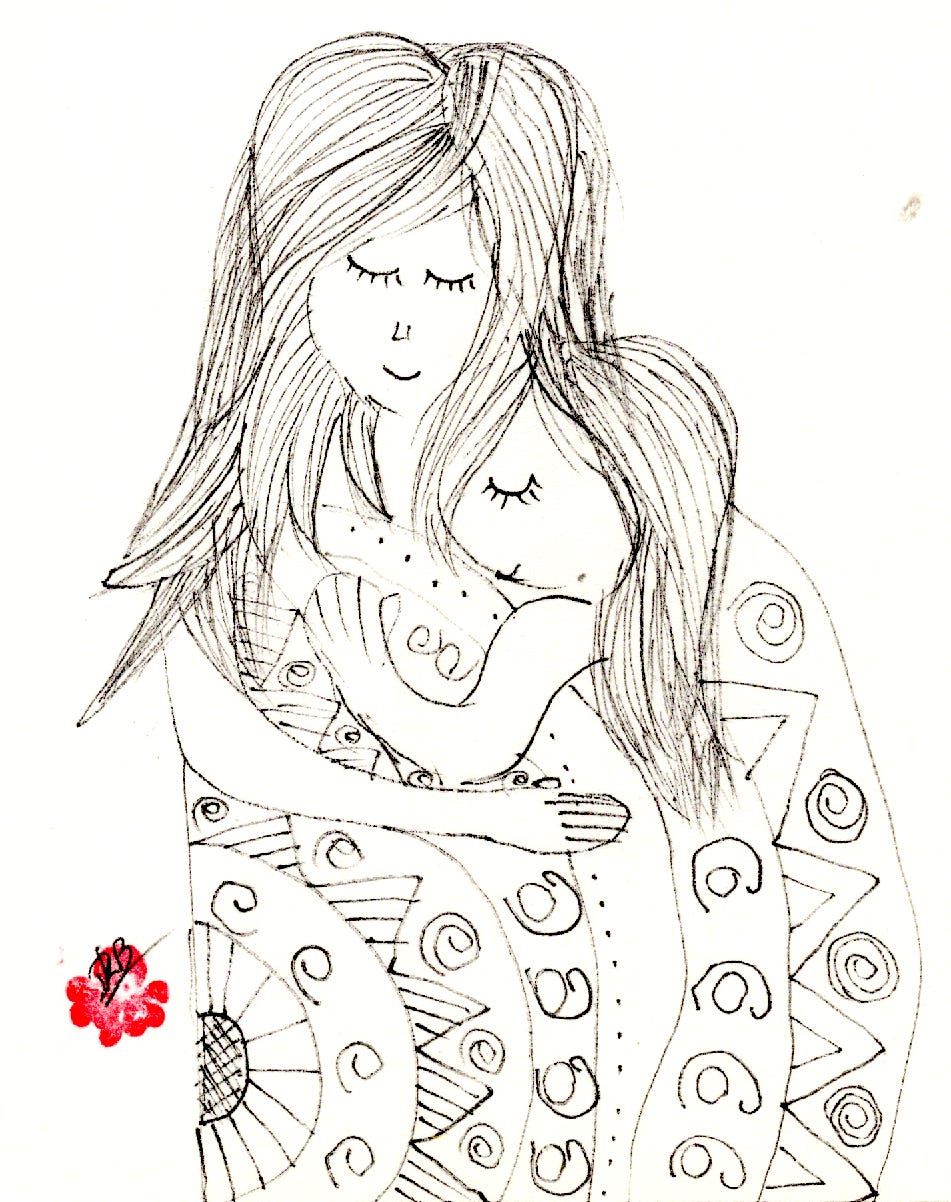
The first thing she asked was whether I had eaten.
Of course she did.
Mothers.
A nurse came in carrying a plate of bread poha, something I had never seen before. Everything about the hospital still felt unfamiliar, yet when mummy fed it to me, I ate as though I had known it my entire life.
Her presence made even the unfamiliar feel familiar.
While I sat in her arms, everything became correct again.
I told her about the rajma chawal.
How it did not taste right.
How I wanted the correct rajma chawal.
How daddy and I had come to take her home so she could make it.
She laughed.
Not at me.
The sort of laugh mothers reserve for worries that are enormous to a child and impossibly tender to everyone else.
Then she hugged me tighter.
She promised she would come home soon.
I remember feeling angry.
Let down.
Why not now?
Why not with us?
Somewhere in the middle of our conversation, she glanced towards daddy. It lasted only a moment. A look exchanged between two people carrying far more than they intended their child to see.
I did not understand it then.
I understand it now.
Parents spend an astonishing amount of their lives standing between their children and fear.
Only years later did I begin to understand what had unsettled me.
It wasn’t simply that mummy wasn’t home.
It was that, for the first time in my life, my parents were no longer moving through the world together.
Morning tea shared before the house stirred awake.
Evening walks.
Errands done together.
Groceries purchased together.
One calling out to the other from another room.
One remembering what the other preferred.
The thousands of ordinary acts of attention from which a life is built.
As a child, I simply assumed this was how the world worked.
My parents moved through it side by side.
Only much later did I realise why seeing daddy walk back through our front door alone had felt so profoundly unfamiliar.
For the first time in my young life, I was looking at only half of something I had always known as whole.
I realise now that my mother’s rajma chawal was never merely rajma chawal.
It was a form of being known.
She added more rice because I could not tolerate much spice. She never mixed it completely because what if that particular spoonful proved too fiery for me. She gave me more rajma than tarri because she knew I liked the beans but not the heat.
I did not know it then, but she had memorised my hungers.
Looking back, I think love often reveals itself as attention.
Not grand gestures.
Not declarations.
Attention.
Knowing how much rice belongs on a child’s plate.
Knowing which spoonful may be too spicy.
Knowing when to ask whether they have eaten.
Knowing when to laugh.
Knowing when to reassure.
Knowing when to open your left arm and make the world feel correct again.
For years I thought the inheritance passed through our kitchen was food.
Now I suspect it was attention all along.
My mother did come home.
And yes, eventually there was rajma chawal again.
The correct rajma chawal.
The rice sat where it belonged. The tarri no longer threatened to overtake the beans. She added the extra spoonful of rice before setting the plate in front of me and, just as she always had, left the rajma and gravy unmixed so I could decide how adventurous I felt that day.
Everything was exactly as it had been.
And yet, somehow, it wasn’t.
Looking back, I don’t think that rainy night changed the rajma chawal.
I think it changed me.
I began noticing my mother’s absences in a way I never had before.
If she stepped into another room for too long, I found myself listening for her voice.
If she went to visit a neighbour, I waited for the familiar sound of the gate.
If the house grew too quiet, I would wander from room to room until I found her.
I did not think of it as fear.
Children rarely possess language for such things.
I simply preferred knowing where my mummy was.
Only now do I recognise it for what it was.
Attention.
The same quiet attention she had given me every day of my life had, without either of us noticing, taken root within me.
Other things had begun changing too.
Not dramatically.
Not in ways a visitor would have noticed.
Life simply rearranged itself, almost imperceptibly, around care.
My sister spent more time in the kitchen.
Not because anyone instructed her to.
Not because my mother announced lessons or handed down recipes.
She simply stood closer.
She watched.
She stirred.
She listened.
The curriculum had already begun.
The kitchen, I would later come to understand, is rarely a place where knowledge is formally taught. It is absorbed through proximity. Through repetition. Through watching someone else’s hands until, one day, your own seem to know what to do before your mind has caught up.
For years I believed recipes were what travelled from one generation to the next.
Now I think it was something much quieter.
Attention.
My daddy appeared in the kitchen more often too.
At first, I don’t think I noticed.
Children rarely notice the quiet rearrangements that keep a household standing.
They simply continue being children.
Looking back, however, I remember him everywhere.
At the sink.
At the chopping board.
Washing vegetables.
Drying utensils.
Pounding ginger.
Grinding spices.
Preparing tea.
Small acts, easily overlooked.
Yet they remain among the clearest memories I have of that time.
Back then, I thought he was helping.
Years later, I began wondering whether he was doing something far more profound.
Love rarely announces itself while it is happening.
More often, it rolls up its sleeves and gets to work.
My father has never been a particularly religious man in the conventional sense. My mother carried that devotion more visibly.
His faith has always lived somewhere quieter.
There is a steadiness about him, a connectedness to the world that seems to exist beyond ritual and beyond explanation.
Perhaps that is why his name has always suited him so well.
Kartar.
Creator.
Maker.
One who participates.
Around that time, I also noticed him spending more time at the Gurudwara.
Even now I cannot say with certainty why.
Did he go for her?
For himself?
For us?
Perhaps love eventually becomes all three.
Or perhaps this is simply what people do when they find themselves standing before things they cannot mend.
They pray.
They serve.
They show up.
And somehow, that becomes enough.
Looking back now, I realise my parents were teaching the very same lesson, though in different languages.
My mother taught it through nourishment.
My father taught it through service.
Neither spoke of sacrifice.
Neither explained devotion.
They simply lived it, day after ordinary day.
Looking back, I suspect my parents had spent decades memorising one another.
Not unlike my mother memorising how much rice belonged on my plate.
They knew one another’s rhythms.
One another’s habits.
One another’s silences.
One another’s joys.
One another’s burdens.
Love, I have come to believe, is rarely built from grand moments.
More often, it is assembled from thousands of ordinary acts of attention repeated over a lifetime.
A cup of tea.
A prepared meal.
A shared walk.
Groceries carried home together.
A question asked at exactly the right moment.
As children, we rarely notice these things while they are happening.
We simply grow up inside them.
Only later do we understand how much love was required to make such ordinary days appear effortless.
I do not fault the adults who put us to bed that rainy night.
They were doing what they believed was right, in the only way they knew how.
They belonged to a generation that believed childhood should remain untouched by certain truths for as long as possible. Illness happened behind closed doors. Worry spoke in hushed voices. The grown-ups carried burdens their children would not have known how to bear.
I am grateful for that shelter.
Only later did I come to understand that every generation receives the childhood its times permit.
Ours was one of quiet protection.
The children growing up today seem to inherit a different world. They are often invited into conversations we would never have heard, entrusted earlier with uncertainty, and asked to make peace with the fragile truth that the people they love most are not promised to them forever.
I do not know whether one way is wiser than the other.
I only know that we understand it later.
We understand why our parents whispered.
Why they smiled when they were tired.
Why they carried worry behind closed doors.
Why they believed that preserving a child’s certainty, for just a little longer, was itself an act of love.
Food, I have come to believe, is often the doorway.
Memory is the room beyond.
A familiar dish has an uncanny way of returning us to the people who first taught us what safety tasted like. Not because recipes possess magic, but because love has a habit of lingering in the smallest acts of attention.
An extra spoonful of rice.
Less tarri.
A cup of tea prepared without asking.
A shared walk at the end of the day.
The quiet certainty that someone has been paying attention.
Perhaps this is why certain dishes endure long after the meal itself has ended.
They become our quiet rebellion against impermanence.
Not because they allow us to hold on to those we love.
But because, each time we prepare them with the same careful attention, a small part of their way of loving continues through our own hands.
Sometimes I wonder whether that is what inheritance has always meant.
Not recipes.
Not ingredients.
Not even memory.
But the slow and generous passing of attention from one heart to another, until one day we find ourselves caring for someone else in ways we never consciously learned.
And somewhere, I like to believe, there is still a little girl who takes comfort in knowing that the correct rajma chawal was never really about the rajma chawal at all.
It was about being known.
About being loved so attentively that someone memorised your hungers before you were old enough to understand what love looked like.
I have spent years thinking I inherited my mother’s recipes.
Now I know I inherited something far greater.
I inherited the way she loved.
Even now, whenever I serve rajma chawal, I still leave the rajma and the tarri unmixed. I don’t think my hands know any other way.
Each and every word in which you describe rajma chawal shows that it's not about the rajma chawal you describe your parents love for their children ❤️❤️
Such a beautiful, moving piece, Chef Daljeet. What especially touched me is this line:
“Food, I have come to believe, is often the doorway.
Memory is the room beyond.”
I loved how the blog has oscillated between your emotions towards parents and the food. 🩷 Amazing!