
What Cooking Gave Me When Everything Else Felt Untethered
Recipes, memory, migration, and the quiet rituals that teach us how to belong.

When I first arrived in America decades ago, life felt wonderfully expansive and, at times, beautifully untethered.
Everything felt new, the cadence of conversation, grocery aisles lined with unfamiliar brands, holidays I did not yet understand, social customs that took time to decode, even the ordinary choreography of daily life, which suddenly felt slightly rearranged.
There is a peculiar exhilaration in beginning again, though it does ask something of you: a certain humility, a willingness to remain curious, and a quiet resilience you may not realize you possess until life gently asks it of you.
And so, without any grand intention, I found myself returning to the kitchen.
Not because I imagined food would become such a defining thread in my life.
Not because I had some lofty culinary ambition.
But because cooking spoke a language I already understood.
Before I fully understood neighborhoods, idioms, or the subtle rhythms of this new chapter, my hands already understood the language of the kitchen.
There is a particular comfort in reaching for what your hands remember, especially when the rest of life is still introducing itself.
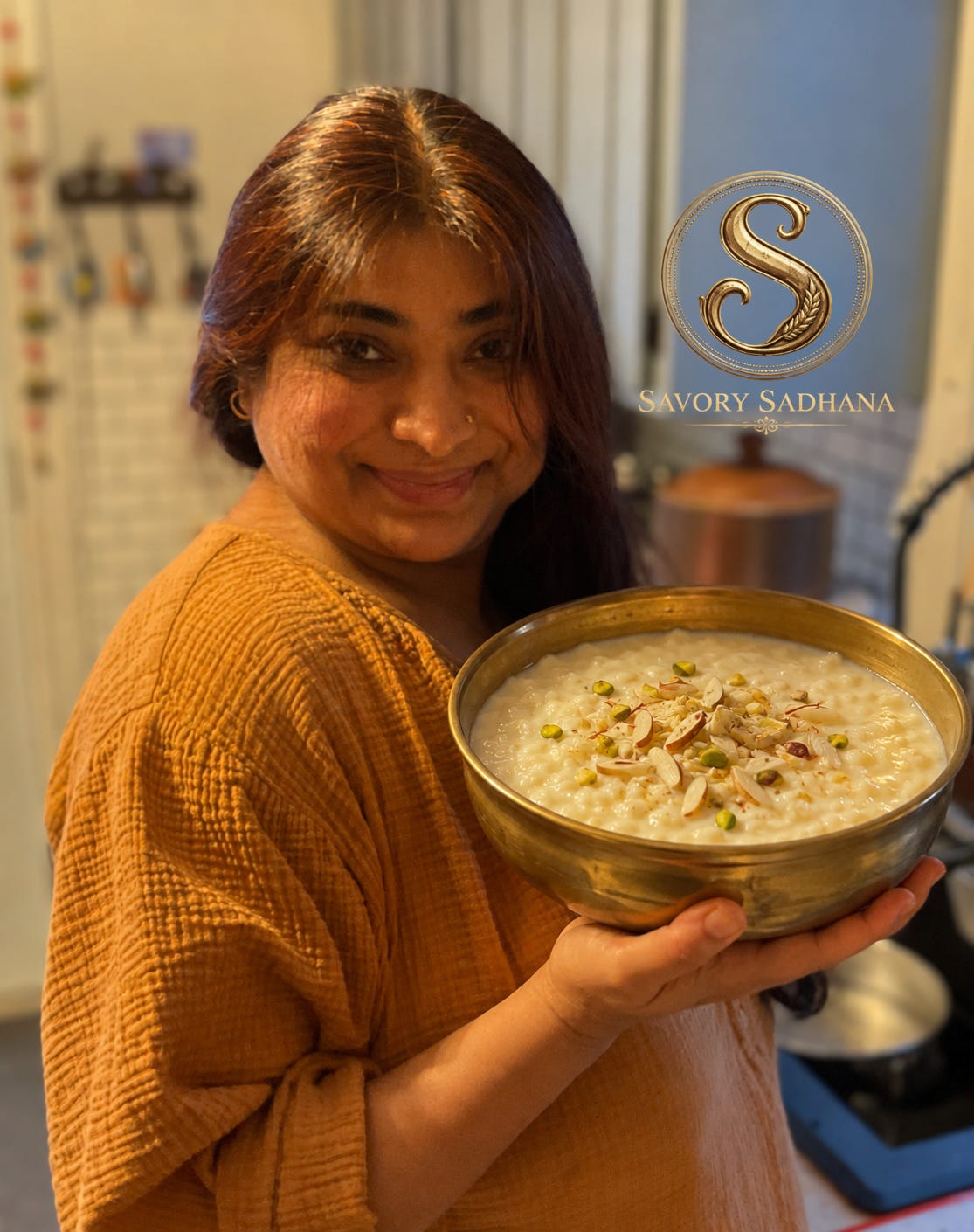
Some evenings, that comfort looked like kheer.
Milk slowly thickening on the stove.
Rice surrendering its edges.
Cardamom opening under gentle pressure.
The kitchen growing fragrant in that unmistakable way that can collapse years and continents in an instant.
I was no longer merely making dessert.
I was preparing something that reminded me, quietly but unmistakably, that familiarity still existed.
Cooking did not feel like performance.
It felt like continuity.
I grew up in a Sikh household where food was never simply about feeding one’s own family.
The kitchen was a place of care, certainly, but also of service.
If you grow up around the tradition of langar, the Sikh community kitchen, you absorb its lessons long before you have the words to explain them.
You remember sounds first.
Steel utensils clattering in practiced rhythm.
The soft percussion of rolling pins against wooden boards.
The gentle, continuous cadence of Gurbani drifting through the gurdwara, weaving itself through the fragrance of simmering dal and freshly prepared tea.
Tea poured generously and repeatedly, because one cup was rarely the end of the conversation.
And always, people seated together.
Shoulder to shoulder.
Without ceremony.
Without hierarchy.
Without anyone needing to explain why that mattered.
No one formally teaches a child that dignity belongs equally to everyone.
But when you witness a laborer, a businessman, a grandmother, a student, and a visitor all sharing the same meal on the same floor, each received with equal dignity, without regard for caste, wealth, race, creed, or social standing, something settles quietly into your bones.
Food, in that world, was never spectacle.
It was generosity made visible.
It was humility in practice.
It was nourishment without condition.
Looking back now, I can see how profoundly that shaped me.
Perhaps that is why offering comfort, care, and nourishment has never felt transactional to me.
Even now, preparing a meal feels less like completing a task and more like participating in a legacy shaped by those who came before me, and by a belief that food remains one of the simplest and most meaningful ways we care for one another.
Over time, here in America, something subtle began to happen.
The meals I first cooked simply to comfort myself began inviting others in.
Some of the most meaningful conversations of my adult life began with someone asking:
“What is that aroma?”
A curious neighbor lingering at the doorway.
A guest asking for another helping.
A friend admitting they had never tasted something quite like this before.
Someone unexpectedly sharing a story about their own grandmother’s kitchen.
That is the quiet magic of food.
It slips past formality.
A thoughtfully prepared meal asks very little of us except openness.
Community, I have learned, rarely arrives dramatically.
More often, it gathers gently, between second helpings, over steaming cups of chai, or in the pause after someone says, “This reminds me of something I cannot quite place, but somehow it feels familiar.”
Much like music, food has a remarkable way of moving past language, accent, geography, and assumption.
A wholesome meal does not demand perfect understanding.
Warmth rarely needs translation.
And somewhere along the way, cooking became far more than familiarity.
It became companionship, a form of expression, an offering, and a way of building belonging, one shared table at a time.
Long before Savory Sadhana had a name, this was already the quiet work of my life.
The quiet act of nourishing.
The gathering.
The instinctive reaching for what felt familiar.
The deep, wordless joy of watching someone soften over a thoughtfully prepared meal.
If there is one thing life has taught me, it is this: we rarely arrive in one another’s lives through grand declarations.
More often, we arrive gently.
Through an offered cup of tea.
A question about an unfamiliar aroma.
A shared table.
A second helping pressed lovingly onto a plate.
We imagine that what we carry across oceans are recipes.
But perhaps what we truly carry are ways of nourishing, ways of welcoming, ways of saying you belong here without ever needing to speak the words aloud.
And perhaps that is what Savory Sadhana, pronounced Suh-vuh-ree Saa-dhuh-naa, has always meant to me.
For those unfamiliar, sadhana is a Sanskrit word often understood as a devoted practice, a path undertaken with intention, discipline, and heart.
So while savory speaks to flavor, nourishment, and the joy of the table, sadhana speaks to something quieter and deeper: the daily practice of care, presence, and mindful offering.
Perhaps that is why this name felt so natural.
Because this was never simply about recipes.
It was always about what happens around them.
The stories that unfold while something simmers slowly on the stove.
The conversations that begin over a shared cup of tea.
The memories unexpectedly awakened by a familiar fragrance.
The quiet ways food reminds us that we belong to one another.
If you choose to linger here with me, you will find more than dishes and ingredients.
There will be stories from kitchens both remembered and still unfolding.
Reflections on heritage, migration, hospitality, and the deeply human act of nourishing one another.
A few well-loved family recipes, certainly.
Perhaps a humble bowl of kheer one day, or a discussion about why certain spices seem to know exactly when we need them.
And, I hope, the kind of conversations that make strangers feel a little less like strangers.
Because if life has taught me anything, it is that some of the most meaningful connections begin not with grand introductions, but with a simple question:
“What is that aroma?”
So consider this your invitation.
Pull up a chair.
There is still much left to share.
So beautifully expressed. Every word touches the heart and sounds like it came straight from the soul 💓
So beautifully expressed… i could feel it and it took me the aromas of your kitchen and to the gurudwaras and langar too. Food has a way of bringing people together, almost like magic that creates connection. And the process to me feels like meditation.