
The Vessels That Hold Us
On why the Indian kitchen has never treated a pot as just a pot

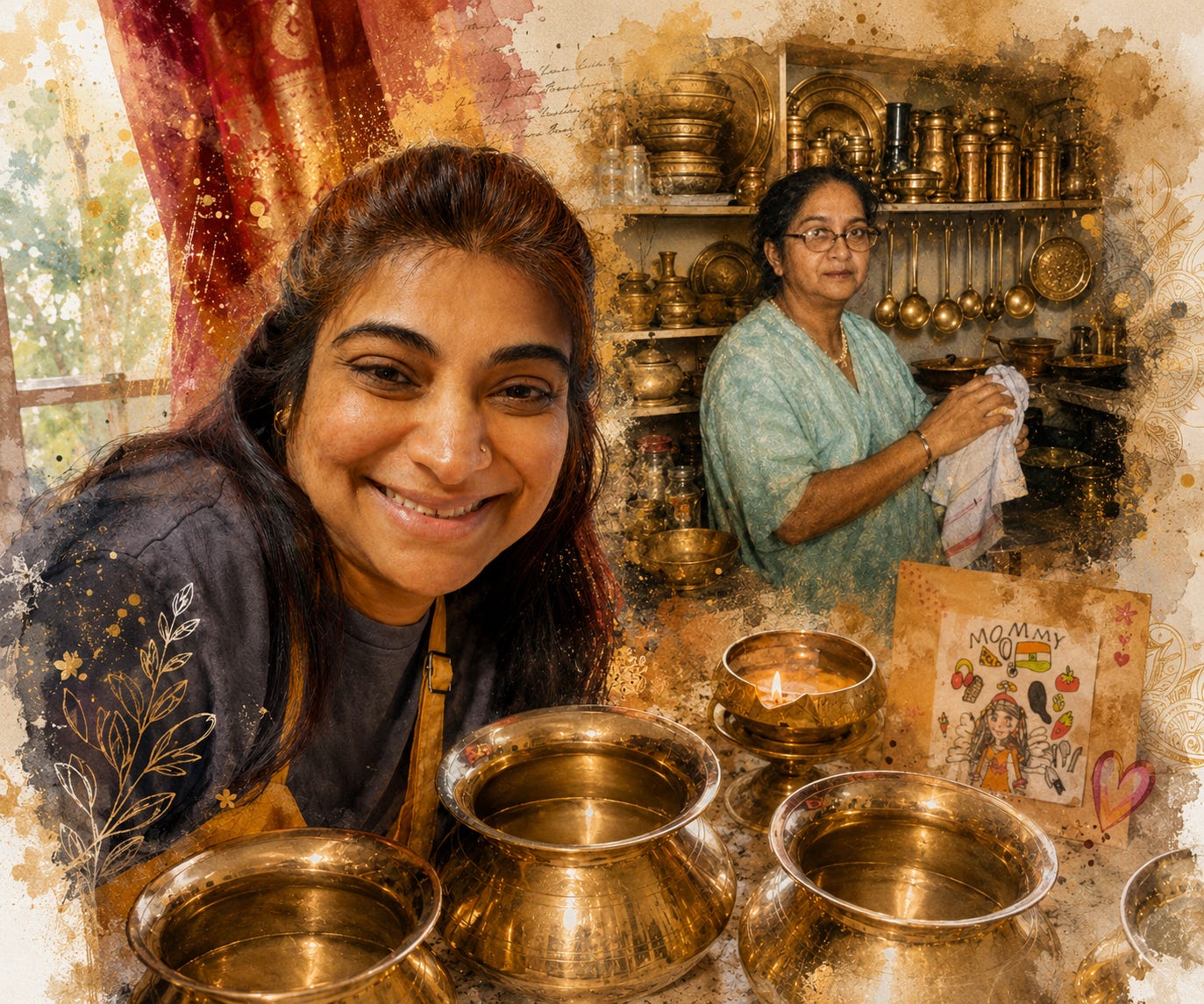
The vessel has been waiting patiently.
Which is only proper.
A good vessel understands timing.
Before this moment, the pantry has gathered itself. The living ingredients have arrived with their temperaments. The fat has received the first fragrance. The hand has crushed, torn, pressed, ground, kneaded, and coaxed ingredients into readiness.
Now something must receive the transformation.
Not merely contain it.
Receive it.
With heat. With surface. With temperament. With the old patience of matter that participates without applause.
I use the word vessel deliberately.
Utensil is not wrong, but it feels too thin for what I mean here. A utensil performs a task. A vessel receives. It carries. It keeps. It asks to be understood not only by function, but by relationship. In the Indian kitchen, and in the ritual life that often lives beside it, what carries something is rarely treated as incidental.
Perhaps this distinction becomes especially tender in diaspora kitchens, where bartan rarely means equipment alone. A steel plate, a pressure cooker, a tawa, a dabba, a small copper cup tucked carefully into luggage. These things often become portable continuities. Not home itself, perhaps, but evidence that home has sent a representative.
And anyone who has ever watched an Indian suitcase being packed around suspiciously heavy kitchen objects will know that sentiment and excess baggage allowance have long maintained a complicated relationship.
I did not always understand this with any great clarity.
For years, I used what was available, what was practical, what survived apartment moves, hurried dinners, tired evenings, and the general optimism of modern kitchen aisles. Like many of us, I thought I was simply cooking.
Then pregnancy arrived and began questioning every life choice I had ever made.
Not politely.
Pregnancy, in my experience, does not make gentle suggestions. It walks into the room like an elder with no interest in your excuses and begins rearranging your priorities.
Suddenly I was looking at my kitchen differently. The plastics looked suspicious. The nonstick looked suspicious. The shiny convenience of everything began looking suspicious. Even I looked suspicious to myself, standing there with swollen feet, ancestral anxiety, and the sudden conviction that my unborn child required not only nutrients, but a kitchen with better moral foundations.
I cannot claim this was rational in the tidy modern sense.
It felt older than rational.
Some dormant ancient wisdom, or perhaps just a very dramatic pregnant Indian woman with access to the internet, woke up in me and began asking uncomfortable questions.
What are we cooking in?
What are we serving in?
What are we carrying forward?
What kind of kitchen is this child going to inherit?
And from there, slowly, almost stubbornly, I began making a firmer resolve.
Not to perform tradition. Not to decorate my life with expensive nostalgia. But to begin, piece by piece, moving my kitchen toward something more permanent. More concrete. More rooted.
One bronze kadchi at a time.
One strong iron tawa, built season after season into something no cheerful nonstick promise could replace.
One vessel that would not be discarded simply because a newer version had arrived with a brighter label and a louder promise.
It has taken more than a decade, and I am still not finished. Perhaps no kitchen worth inheriting is ever finished. But season after season, a different kind of permanence has begun to gather.
Not the kind the modern world always recognises. Not a legacy measured only in bank balance, square footage, promotions, or the impressive ability to buy things no one’s grandchildren will remember. Something quieter. Firmer. Older. A legacy of use. Of touch. Of familiar things returning to the flame until they begin to carry the authority of having stayed.
Perhaps this is one of the strange conditions of being Indian abroad.
We become clingy in ways that are almost comic.
Fervently, embarrassingly, beautifully clingy.
We hold on to things with a devotion that may have puzzled our own grandmothers, who were perhaps simply trying to finish lunch before the power went out. Distance does this. It makes ordinary objects luminous. A tawa becomes more than a tawa. A pressure cooker becomes a national anthem in stainless steel. A spice box becomes evidence in the case against forgetting.
We begin preserving, with almost unreasonable ardour, what we sometimes see eroding even in the land of our ancestors.
Not because India is frozen in some perfect past. It never was. India has always been changing, improvising, arguing, adapting, replacing, reusing, upgrading, and occasionally making a complete racket while doing so.
But distance sharpens the ache.
From afar, one sees loss differently. One sees how quickly convenience can flatten memory, how easily plastic can replace brass, how casually “old-fashioned” can become an accusation. And so the diaspora kitchen, with all its compromises and contradictions, sometimes becomes a small stubborn outpost.
A place where we say, perhaps with too much feeling, no, this still matters.
This vessel still matters.
This way of receiving food still matters.
A pot is never only a pot, though modern convenience has made a persuasive case otherwise. A pan is not merely a flat place where ingredients are asked to behave. A vessel is not a silent container waiting politely in the background while flavour happens elsewhere.
The vessel changes the conversation.
Clay remembers.
Iron answers.
Bronze keeps.
Copper dazzles.
Steel stays.
Each one teaches a different kind of attention.
Clay belongs at the beginning because clay was here before the metals began their long, gleaming argument with fire. Even now, when many of us cook on induction tops, electric stoves, glass surfaces, and appliances that beep with the emotional confidence of minor officials, clay has not vanished. It waits in the matka, in the kulhad, in the curd pot, in the festival lamp, in the village kitchen, and sometimes in the modern home where someone has decided that at least one corner of life should still remember soil.
Clay does not announce itself.
It endures.
Iron enters with a different temperament altogether.
A strong iron tawa. A blackened kadai. The old surface no one is allowed to scrub with enthusiasm, because enthusiasm, in the wrong hands, has ruined many good things. Iron does not ask to be admired from a distance. It asks to be used, returned to flame, oiled, dried, forgiven, and trusted again.
It is not delicate.
It is loyal, but it expects loyalty in return.
Bronze carries another kind of authority.
A kansa bowl, a thali, a serving vessel brought out with care. Bronze does not shout. It glows. It belongs to the table, to offering, to guests, to the grammar of feeding someone with dignity. It has the calm of something that knows its worth and therefore feels no need to behave like new money.
Copper arrives brighter.
More beautiful, more demanding, more likely to remind everyone that glamour without knowledge is how trouble begins. Copper catches the eye, yes, but it also asks for manners. Tradition knew this. Older kitchens did not create rules because they were bored and looking for administrative work.
Copper is not difficult.
It is particular.
There is a difference.
And then there is steel.
Faithful, durable, democratic steel.
The pressure cooker that rescues dal before the evening collapses. The dabba that carries lunch. The katori that appears everywhere. The steel thali stacked in apartment cupboards. The storage container holding yesterday’s sabzi, cut fruit, pickle, batter, or whatever else life has insisted must continue into tomorrow.
Steel may not arrive trailing ancestral poetry, but it has fed the modern Indian household with astonishing stamina.
It belongs fully to the story.
Not as a lesser descendant of nobler materials, but as the everyday vessel of survival, migration, thrift, school lunches, train journeys, office bags, rented flats, and hurried weeknight kitchens.
And loyalty, in a kitchen, is no small virtue.
This is why the vessel matters.
Not because one material is pure and another compromised. Not because clay is morally superior to steel, or bronze more authentic than the pressure cooker that has saved dinner in ten thousand homes while everyone else was busy having opinions.
That is too small an argument for a kitchen as intelligent as ours.
The point is not hierarchy.
The point is attention.
Each material asks the cook to notice differently. Clay asks us to remember origin. Iron asks us to return. Bronze asks us to serve with presence. Copper asks us to keep knowledge near beauty. Steel asks us to honour ordinary endurance.
Together, they form not a museum, but a household.
And perhaps this is what the Indian kitchen has always understood. Food is shaped not only by ingredient, spice, fat, hand, and flame, but by what receives it. A recipe may say “cook in a pot,” as though the pot were a neutral witness. But any cook who has watched the same dal behave differently in a handi, a degchi, a pressure cooker, or a favourite old pan knows that neutrality is a polite fiction.
The vessel has opinions.
Some whisper.
Some argue.
Some, like pressure cookers, announce themselves to the entire neighbourhood with operatic commitment.
But each participates.
Each leaves a signature. Not always loudly. Not always in a way one can measure neatly. But food knows. The hand knows. The tongue knows. Memory certainly knows.
This is not a call to fill every kitchen with every vessel, as though inheritance were a shopping list. A living tradition does not require a perfect museum of objects. It does not demand that a person in a small apartment acquire clay, iron, bronze, copper, steel, a parat, a lota, three varieties of chimta, and a morally intimidating masala dabba before being allowed to call their cooking meaningful.
One good pan can hold a life.
One pressure cooker can feed generations.
One steel dabba can carry more memory than a cabinet of decorative things no one is allowed to touch.
A vessel becomes meaningful through use. Through repetition. Through the way it enters the rhythm of a household. Through what it survives. Through the meals it receives, the hands that wash it, the kitchens it crosses, the children who eat from it, and the elders who correct someone nearby while pretending not to supervise.
This is why old vessels feel alive.
Not because they are magical, though some of them make a persuasive case.
They feel alive because they have lived near hunger and care.
They have received festival sweets, weekday dal, medicinal broths, hurried breakfasts, offerings, leftovers, and the special dish made because someone beloved was coming home.
They have seen us practical, generous, tired, fussy, impatient, tender, overconfident, corrected, and forgiven.
That is a lot for a pot to know.
Perhaps too much.
No wonder some of them develop attitude.
But this is where the vessel becomes more than object. It becomes witness. It sits at the meeting place of matter and memory. It teaches that what receives the food also shapes the life around it.
So we begin this small journey through the Indian kitchen not with a catalogue, but with a question.
What does each vessel know?
Not everything at once. That would be rude, and also very Indian of us to overfeed the guest before the meal has technically begun.
We will go slowly.
Clay first.
Because clay was here before the gleam, before the blackened authority, before the polished thali, before the pressure cooker whistle, before the induction-compatible base and the dishwasher-safe promise.
There was earth shaped by hand, hardened by fire, and trusted to keep life close.
Clay remembers the beginning.
And perhaps that is why it still waits for us so patiently.
Thank you for this post! Here are some parts I found most stirring:
Inheritances, general:
- "Distance does this. It makes ordinary objects luminous."
I know this, I feel this, & now you have said it. <3
- "One sees how quickly convenience can flatten memory [...] how casually 'old-fashioned' can become an accusation."
Sadly true. Has it always been? Yes or no, 'old-fashioned' seems to be an easily-grasped-for slur when someone doesn't like something with history (or understand it). Often it takes context to appreciate that which may seem 'obsolete', 'quaint', or out-of-place among capitalism's ferocious drive to produce novelty & increase speed.
Vessels, general:
- "A vessel becomes meaningful through use. [...] Through the way it enters the rhythm of a household. Through what it survives. Through the meals it receives, the hands that wash it, the kitchens it crosses, the children who eat from it."
So much love here.
- "They feel alive because they have lived near hunger and care."
- "They have seen us practical, generous, tired, fussy, impatient, tender, overconfident, corrected, and forgiven. That is a lot for a pot to know."
I feel particularly fond of this one.
Moving odes to clay:
- "Clay belongs at the beginning because clay was here before the metals began their long, gleaming argument with fire."
What description!
- "Clay was here before the gleam, before the blackened authority, before the polished thali, before the pressure cooker whistle, before the induction-compatible base and the dishwasher-safe promise."
- "Clay remembers the beginning. And perhaps that is why it still waits for us so patiently."
Other gems:
- "Enthusiasm, in the wrong hands, has ruined many good things."
Can you hear my wry laughter from here? This is my life: in spurts, loads of enthusiasm... with often overpowering execution. X-D
- "Steel may not arrive trailing ancestral poetry..."
Such a pleasing turn of phrase.
As I encounter more of your writing here, it is so interesting to discover your authorial voice. There's usually one or more portions that meander amiably like a babbling brook. And like all waters - even those that move their flow within the earth for awhile - they find their way. Count on it. Your words also deliver poetic phrases routinely; I appreciate the rhythms you find. Interspersed within the sometimes braided flow, you routinely deliver potent kernels that, as a reader, stop me in place. Sometimes I'm surprised and laughing. Others, just profoundly touched.
Wrapping up, there's nothing as potent for me in this whole essay as: "One good pan can hold a life."
Again, brava. <3
Very true.