
The Politics of Fat - Who Receives the Spice First?
On the faithful generals of the Indian kitchen

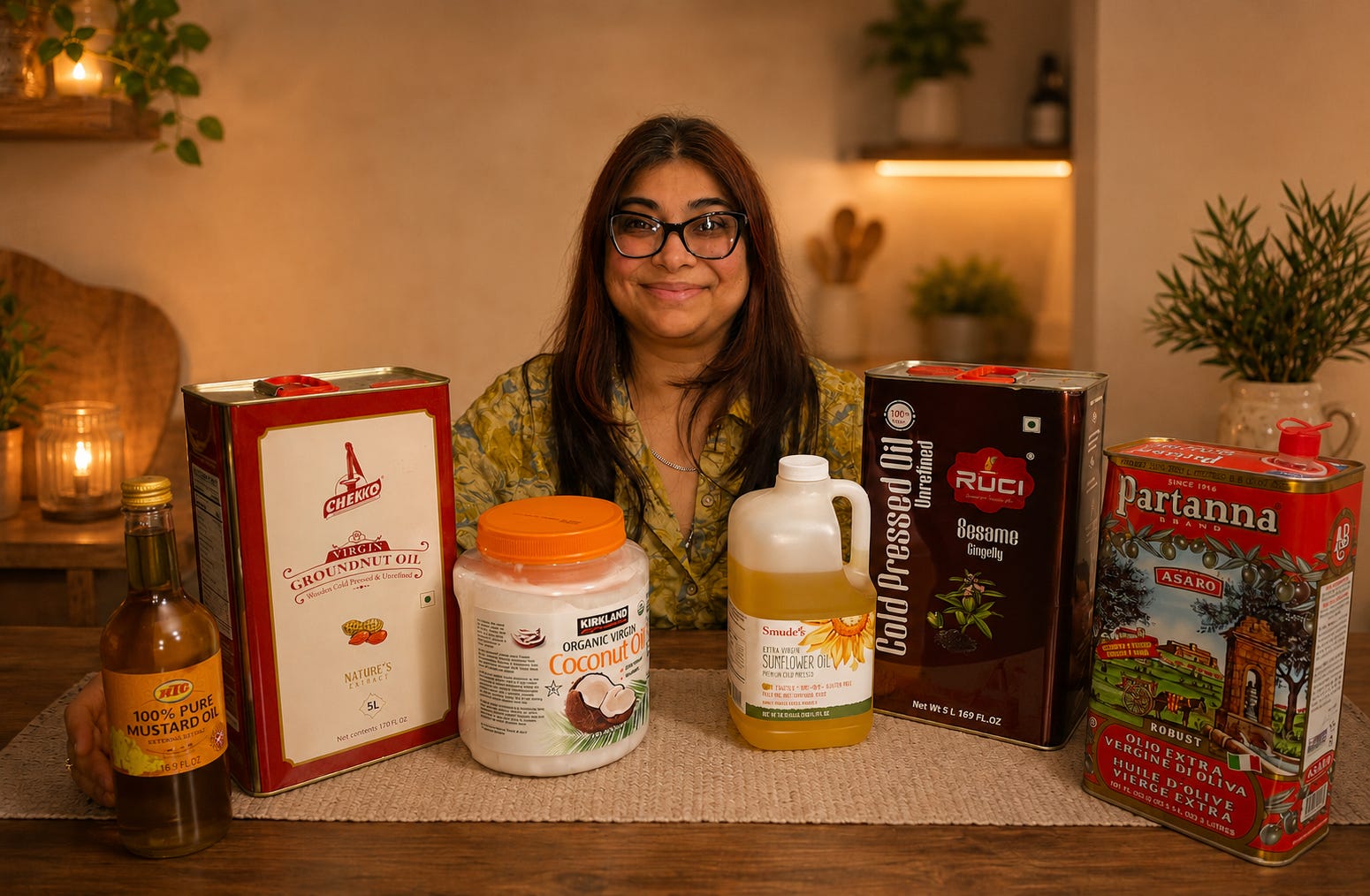
Every proper performance requires a conductor.
In the Indian kitchen, that role often belongs not to the loudest ingredient, but to the one waiting silently in the kadhai(कड़ाही).
Before cumin (jeera, जीरा) blooms into nutty warmth, before mustard seeds (rai / sarson, राई / सरसों) begin their sharp little arguments with hot metal, before asafoetida (hing, हींग) performs that miraculous alchemy by which something initially alarming becomes entirely indispensable, a quieter decision has already been made.
What shall receive the spice first?
At first glance, it appears an ordinary kitchen question. Practical, perhaps. Technical, even.
But linger there a moment, and one begins to understand what is truly being asked.
Not merely which fat?
But whose kitchen are we in?
Whose geography? Whose inheritance? Whose climate? Whose agricultural memory? Whose grandmother, standing with folded arms, saying absolutely nothing and yet somehow making us reconsider our life choices?
Because Indian kitchens, if they are honest, are not neutral territories.
They are full of allegiance.
And perhaps rightly so.
Indian kitchens did not choose fats merely for flavour. They chose them because place taught them what worked.
A land that can offer Himalayan snow in one direction, desert wind in another, salt-heavy coastlines elsewhere, monsoon-soaked abundance in one season, parched waiting in the next, and tropical humidity determined to humble even the most well-composed cook would be rather suspicious if it all agreed on one cooking medium.
India, bless her magnificently contradictory heart, has never shown much enthusiasm for culinary uniformity.
These faithful generals did not arrive because some enterprising modern committee held a symposium and declared them appropriate. They arrived because generations of cooks paid attention - to weather, to harvest, to what the body asked for in winter, to what would turn oppressive in relentless summer heat, to what kept, to what spoiled, to what grew nearby, to what trade brought in, to what worship sanctified, to what the household purse could tolerate without open mutiny, and, perhaps most importantly, to what made the food taste unmistakably like home.
That is not trend forecasting.
That is ancestral competence.
A Punjabi kitchen may reach instinctively for ghee (घी) or white butter (makkhan, मक्खन) with the unhurried confidence of old abundance.
A cook in Jammu, Kashmir, Punjab, Haryana, or stretches of the Gangetic north may know mustard oil (sarson ka tel, सरसों का तेल) not as novelty, but as familiar household language.
A Bengali kitchen, naturally, may regard that same mustard oil not merely as preference, but as something approaching constitutional right.
Mustard oil does not enter a room hoping to be liked. It arrives with opinions - sharp, pungent, entirely uninterested in bland diplomacy. It asks whether you possess sufficient character to proceed.
In Tamil kitchens, sesame oil (nallennai / तिल का तेल) carries itself differently. Less argument. More elder statesman. The sort of ingredient that need not raise its voice because it has been correct for a very long time.
Travel further along the coasts, and coconut oil does not politely introduce itself so much as declare, with fragrant certainty, that we have entered an entirely different culinary theology.
Elsewhere, peanut oil appears without fanfare, which is often how truly dependable things behave - practical, steady, economically sensible, deeply woven into the quiet arithmetic of daily cooking.
Every thirty kilometres, it sometimes seems, the subcontinent revises its culinary constitution.
And everyone remains entirely convinced their grandmother’s interpretation is the legally binding one.
Some kitchens season with ingredients.
Indian kitchens often season with allegiance.
And this is before we have even begun cooking.
Modern life has developed a rather exhausting habit of placing food on moral trial.
Particularly fat.
Poor thing.
Depending on the decade, it has been seductress, saboteur, public enemy, reluctant apology, or the nutritional equivalent of questionable character.
Too rich. Too indulgent. Too heavy. Too much.
One half expects ghee to arrive carrying a written statement of remorse and a recommendation letter from a cardiologist.
Older kitchens, mercifully, possessed far less theatrical anxiety. They understood fats not as moral failings, but as working members of the household. Trusted ones. The sort entrusted with serious introductions.
Because spices, for all their brilliance, are not always easy company.
Some need coaxing. Some require heat and persuasion. Some refuse to reveal themselves unless properly received.
Fat was never merely there to make food richer. It was there to carry fragrance where water could not, to soften sharpness, to round edges, to wake sleeping aromatics, and to make disparate things speak to one another.
Not villain.
Not nutritional virtue.
Not dietary confession.
But conductor.
Carrier.
Translator.
Faithful general.
If one wishes to understand Indian cooking fats properly, one must travel.
Not through recipe books.
Not through nutrition headlines.
Certainly not through the sort of internet discourse that behaves as though all oils ought to submit themselves for annual moral review.
Northward, where winter is not metaphor but an actual household participant.
Across wheat country, where dairy abundance shaped both appetite and generosity.
Eastward, where mustard announces itself with all the restraint of an impassioned political speech.
Westward, through pragmatic households where thrift and excellence have maintained a perfectly respectable marriage for generations.
Down through the Deccan, where sesame carries the perfume of continuity.
And further still, toward coastal air thick with salt and coconut, where certain culinary decisions ceased to be decisions long ago.
But before we start assigning passports to every bottle in the pantry, perhaps it is only fair to introduce the personalities properly.
Ghee, perhaps, is the easiest elder to begin with, if only because so many Indian households have known its comforts in one form or another.
Though comfort, in Indian kitchens, should never be mistaken for simplicity.
Ghee does not merely cook. It consoles, restores offended spirits, and lends generosity where austerity has overstayed its welcome. It finds its way into food prepared for honoured guests, winter tables, ritual offerings, festive sweets, convalescent meals, and occasionally for children who have learned, quite correctly, that anything made with generous quantities of ghee deserves a second, unofficial serving.
In colder geographies, where the body must negotiate honestly with winter, austerity is a charming concept best left to poets and people who do not cook.
A spoonful of ghee in such places is not indulgence. It is practical intelligence. A quiet domestic assurance that someone, somewhere, was thinking ahead.
And yet to describe ghee merely as clarified butter feels strangely inadequate.
As though one had mistaken inheritance for chemistry.
Not incorrect.
Just spectacularly lacking in understanding.
Ghee, after all, has never confined itself politely to the kitchen.
It appears wherever nourishment and reverence have historically found common cause - in the flicker of a diya, in temple offerings, in festive sweets prepared with seriousness rather than approximation, in restorative food sent toward the unwell with instructions that sound remarkably like blessings, and in meals where love is expressed less through speech and more through insistently adding just one more spoonful despite increasingly theatrical protests.
Ghee has earned its place.
Not because anyone crowned it.
But because it kept arriving wherever bodies needed nourishment, spirits needed comfort, prayers needed flame, and food needed generosity.
Mustard oil, naturally, would find this entire conversation unbearably restrained.
It has no patience for gentle introductions. Mustard does not drift quietly into domestic life like some agreeable background character. It makes an entrance - sharp enough to announce itself before the pan has fully committed, bright enough to wake both appetite and opinion, entirely uninterested in universal approval.
One suspects mustard oil would rather be respected than liked, which is, frankly, a very particular kind of confidence.
If ghee is the beloved elder, mustard is the argumentative aristocrat.
Sharp-featured, opinionated, entirely persuaded of its own legitimacy, and rather offended that anyone thought introductions were necessary.
In Bengali kitchens, questioning mustard’s rightful place may be interpreted as a mildly reckless social choice.
Elsewhere, from Jammu and Kashmir through Punjab, Haryana, Bihar, Assam, and beyond, the loyalties remain equally sincere, merely expressed in different accents.
Mustard asks something of the cook - competence, attention, and a willingness to understand heat not as vague suggestion, but exact instruction.
It is not for the emotionally indecisive.
Nor, if we are being honest, for those hoping every ingredient will behave pleasantly.
But then, not all worthy companions are agreeable.
Sesame, by contrast, has no interest whatsoever in this sort of drama.
Sesame does not announce itself. It simply arrives already certain of its place.
Particularly in Tamil kitchens, where nallennai is not novelty but inheritance, sesame possesses the kind of authority that comes from having survived long enough to become unquestionable.
Its fragrance feels older than explanation. Older than urgency. Older, perhaps, than the modern compulsion to interrogate every inherited instinct until it has submitted its credentials and satisfactorily explained itself to modern suspicion.
Sesame smells like continuity.
Like temple stone still warm from the afternoon sun.
Like bronze vessels polished not for admiration, but because that is simply what one does.
Like the kind of wisdom that does not repeat itself because it assumes you were paying attention the first time.
There is dignity in that.
And then, as though this gathering required a guest who understands abundance in all its glorious practicality, coconut arrives.
Not delicately. Not apologetically. Simply as fact.
To reduce coconut merely to ingredient is almost rude.
Coconut is food and oil, milk and chutney, sweet comfort and savoury necessity, ritual offering and everyday practicality. It is also occasional evidence that Indian kitchens have never believed in underachieving when one ingredient could reasonably perform six jobs.
One does not earn the title kalpavriksha - the wish-fulfilling tree - by being modest in one’s contributions.
Some ingredients nourish.
Others become cosmologies.
Coconut has long belonged to the latter category.
In coastal kitchens, coconut requires no justification. Its place there feels as inevitable as the ocean itself - vast, ancestral, breathing against the edges of the land, shaping appetite and memory long before modern food anxieties learned to speak.
Of course it belongs there.
What else should households intimately acquainted with humidity, coastline abundance, tropical generosity, and groves full of practical miracles use with such fluency?
To express surprise at coconut’s place in these kitchens would be rather like expressing astonishment at fish knowing how to swim.
And then, because every gathering eventually reveals the quietly formidable guest who never felt compelled to advertise their virtues, groundnut oil enters.
Not with ceremony.
Certainly not with mustard’s theatrical instincts.
And not with ghee’s ancestral gravitas.
Groundnut has no apparent interest in commanding the room, which is perhaps precisely why it has fed so many rooms so faithfully.
Western and central Indian kitchens have long understood something modern discourse occasionally forgets - quiet things are not lesser things.
In Gujarat, Maharashtra, stretches of Madhya Pradesh, Chhattisgarh, Vidarbha, and beyond, where pragmatism has always maintained a perfectly respectable partnership with culinary excellence, groundnut oil has occupied not some apologetic corner of the pantry, but an entirely respectable place at the table.
And deservedly so.
Its gifts are not theatrical, but they are substantial - a certain steadiness, a balanced temperament, a willingness to carry flavour without insisting on becoming the only story in the room, and a nutritional generosity of its own that has nourished households long before contemporary food discourse began issuing contradictory verdicts every few years.
One hesitates to mention such matters for fear modern conversation will immediately drag the poor bottle before a tribunal, but there is genuine intelligence here.
Not merely economy.
Not merely accessibility.
But compatibility, balance, dependability, and the quiet blessing of an ingredient that knows how to serve daily life with grace.
Not every faithful general arrives on horseback.
Some arrive without fanfare, govern competently, and leave entire provinces well fed.
Groundnut, if anything, has suffered from the peculiar modern assumption that modesty signals inferiority.
Indian kitchens have generally known better.
Practicality, in our traditions, has never meant absence of discernment. Quite the opposite. It has often meant knowing precisely where abundance is called for, where restraint is wise, and how to nourish a household generously without surrendering flavour, dignity, or health at the altar of performance.
That is not compromise.
That is stewardship.
And central India, so often rudely omitted whenever broad conversations attempt to flatten Indian food into neat regional caricatures, has long practiced precisely this kind of culinary intelligence.
As indeed it should.
A civilization this vast was never going to arrange its loyalties according to theatrical hierarchy.
Of course, personality alone does not explain loyalty.
Even the most charming aristocrat must eventually prove useful.
And this is where Indian kitchens become particularly revealing.
These fats were never chosen merely for sentiment, nostalgia, or inherited stubbornness, though heaven knows we are capable of all three. They endure because they do something unmistakable.
The moment heat enters the conversation, so does transformation.
What was quiet becomes articulate. What was dormant begins to speak. A pan that moments earlier held only possibility now carries fragrance, memory, appetite, announcement.
This is not merely cooking.
It is invocation.
The fat is not background. It is medium, interpreter, and sometimes even priest.
Because not all introductions are equal. Some ingredients arrive gently. Others must be persuaded. Some require warmth, some ignition, and some only reveal their better selves under precisely the right company.
Indian kitchens, being attentive and occasionally gloriously opinionated places, have always understood this instinctively.
A tempering - tadka (तड़का), chaunk (छौंक), baghaar (बघार) - is never merely functional.
It is theatre.
The unmistakable crackle from another room.
The fragrance that announces itself before the food does.
The household equivalent of a herald arriving breathless with important news.
One may substitute, of course.
Civilization will survive.
But the conversation changes.
The accent shifts.
And attentive kitchens have always noticed.
Perhaps that is what unsettles modern discourse most.
Not that traditional kitchens possessed perfect answers. But that they possessed attentiveness.
An attentiveness difficult to monetize, difficult to simplify, and maddeningly resistant to neat universal declarations.
Indian kitchens have rarely worshipped abstraction. They have always been more interested in consequence.
How did the food taste? How did the body respond? Did it nourish, satisfy, comfort? Would one make it this way again?
This is not carelessness.
It is intimacy.
And intimacy, inconveniently for modern absolutists, does not always fit neatly into universal declarations.
A spoonful of ghee in January Punjab is not having the same conversation as one in coastal May. Mustard in one household carries different inheritances than coconut in another. The body of a field labourer has historically negotiated food differently than the body of someone whose greatest daily exertion is answering emails with increasing emotional fatigue.
Context, annoyingly, matters.
Indian kitchens have always known this, which is perhaps why they remain so gloriously resistant to simplistic nutritional sainthood.
Not because questions of health are unworthy. Bodies matter. Health matters. Longevity matters. No serious kitchen should pretend otherwise.
But somewhere along the way, food discourse acquired the rather unfortunate habit of behaving as though centuries of culinary intelligence ought to present themselves annually before a suspicious committee.
As though every grandmother were expected to produce peer-reviewed justification for why she trusted ghee.
As though mustard oil should issue a formal statement explaining its temperament.
As though sesame must patiently clarify its ancient credentials to someone holding a wellness podcast microphone.
It is all a bit much.
A civilization capable of building entire foodways around season, digestion, labour, fasting, ritual, restoration, convalescence, fertility, climate, and agricultural reality was hardly improvising blindly between lunch and tea.
The intelligence was simply framed differently.
Not in hashtags.
Not in villain narratives that change every decade.
But in observation, attention, and lived consequence.
Perhaps that is the deeper truth beneath all this aromatic politicking.
These fats were never merely ingredients.
They were relationships.
Trusted intermediaries between rawness and refinement, between hunger and satisfaction, between spice and expression.
One does not keep such company for centuries by accident.
And yet, for all this talk of conductors and aristocrats and quietly competent statesmen, one uncomfortable truth remains - even the most distinguished ingredient is only as expressive as the hands - and the vessel - that receive it.
The fat may conduct, but the vessel gives it acoustics.
The hand gives it judgment.
The kitchen gives it memory.
But that, I suspect, is another conversation.
Before I met you, I'd only ever cooked with butter and olive oil as my fats. I had no idea what any oils were good for. Living with you, and learning from you, I've come to appreciate the nuance and relationships between the fats and the other ingredients - even if I don't know it all. You are the kitchen genius, as I like to say :)
This essay(?) / post feels like an entirely sensible, realistic retort to what the health industry has been doing to people's minds about food. Thank you!
Also, a couple spots that really stood out to me (among many):
- Coconut cultivation as: "groves full of practical miracles"
- "Practicality... has never meant absence of discernment... It has often meant knowing precisely where abundance is called for, where restraint is wise, and how to nourish a household generously without surrendering flavour, dignity, or health at the altar of performance."
Well said! Hurrah! Brava!