
The Hand, the Stone, and the Secret Life of Flavour
On the old kitchen methods that persuade ingredients to stop keeping secrets

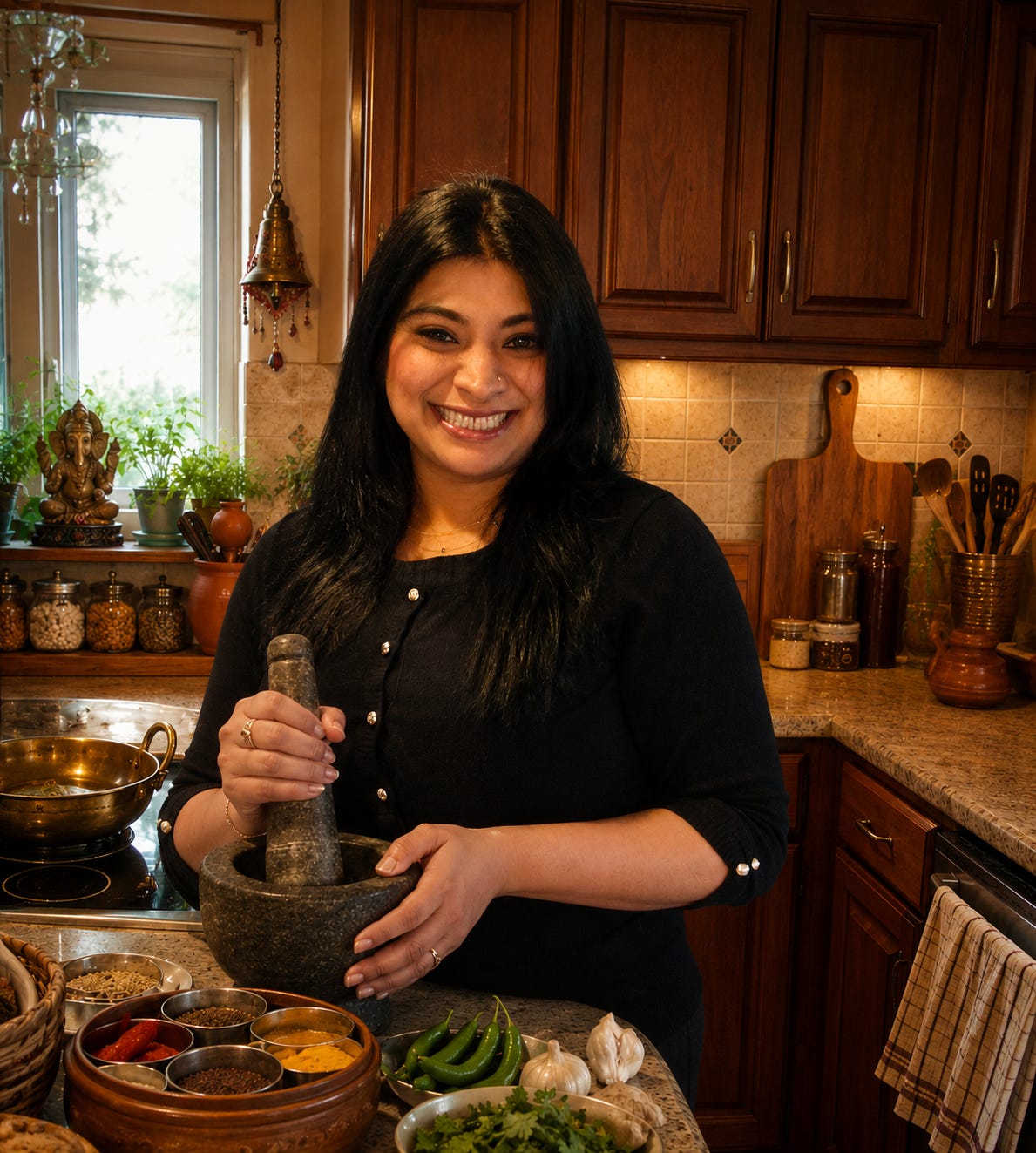
Long before the pot receives anything worthy of dinner, the ingredients have usually endured a private negotiation with the hand.
Not an interrogation. Not a conquest. Something gentler, older, and far more intimate.
A thumb tests the give of an ingredient before the mind has named what it needs. Ginger meets stone and releases its brightness slowly. Coriander is gathered, torn, and scattered with the ease of memory. Garlic, that dramatic little creature, is coaxed from sharpness toward fragrance.
This is not force.
It is attention.
The old Indian kitchen understood something modern appliances sometimes hide behind their buttons, blades, and cheerful promises of efficiency. Flavour is not only released by making things smaller. It is awakened by touch, rhythm, warmth, patience, pressure, and the quiet intelligence of knowing when to stop.
A blender can reduce. A knife can divide. A machine can obey.
But the hand listens.
It knows when a chutney needs one more turn against stone. It knows when ginger has opened enough to become fragrant, and when another enthusiastic assault would be less cooking and more family drama. It knows when roasted cumin is ready not because a timer has shouted, but because the air has changed.
This is knowledge of a different order.
Not mystical, exactly, though anyone who has watched an experienced cook measure salt with her fingers while ignoring all known systems of modern accountability may be forgiven for suspecting divine interference.
The hand is the first instrument of method.
Before the vessel receives, before the fat conducts, before the spices bloom into their small aromatic declarations, something quieter and more intimate has already happened. The ingredient has been touched into readiness.
Not every ingredient wishes to reveal itself in the same way. This, naturally, is where the household drama begins.
Ginger has spine. Garlic gives in more readily, but insists on perfuming the entire room as evidence of its participation. Coriander behaves like someone who had been waiting all along to be invited. Coconut must be grated, scraped, ground, pressed, or coaxed depending on its role and mood, which is a polite way of saying coconut has never lacked self-importance. Chilies, naturally, prefer to keep a little danger in the room.
In the Indian kitchen, method is never merely the dull prelude before the real cooking begins. It is the first conversation between cook and ingredient. The moment when rawness softens its posture. The moment when fragrance steps forward. The moment when texture, temperature, and pressure begin making promises the final dish must keep.
This is why old tools mattered.
Not because our ancestors were secretly plotting to make breakfast more laborious, though certain traditions do occasionally raise suspicions. They mattered because every method leaves its signature.
The sil batta does not simply grind. It drags fragrance slowly out of hiding, the way a good storyteller refuses to rush the important part. A mortar and pestle bring a different temperament altogether, more percussive, more opinionated, slightly more willing to make garlic confess in public. Even the rolling pin, humble little magistrate of the roti board, does more than flatten dough. It teaches it direction, discipline, and, on ambitious days, the emotional resilience required to become round under pressure.
A machine may finish the task quickly.
The old tools change the conversation.
To grind against stone is to lengthen the conversation. The ingredient does not vanish into paste all at once. It changes gradually, under attention, under return, under the repeated music of hand and surface. Seeds crack. Fibres loosen. Oils emerge. Aromas rise not as announcement, but as confession.
There is intimacy in this.
Also, occasionally, arm fatigue.
Let us not romanticise everything beyond recognition. The old ways were not always gentle on the shoulders. Anyone who has ground soaked lentils, coconut, or spice pastes by hand knows that tradition can be beautiful and also mildly interested in your upper-body strength. The past, like certain aunties, rarely offers wisdom without also checking your stamina.
If my sister is reading this, she can testify.
There were many laborious hours in our childhood when idli and dosa batter had to be ground in the traditional stone grinder because some beloved, overenthusiastic relative had phoned my mother a couple of days earlier and said, with the full emotional authority of longing, “Auntyji, twadi idli-dosa bada yaad aa rahya veh.”
And that was that.
My mother, who never seemed to know how to refuse anyone when food was involved, would drop everything and begin. Not reluctantly. Not with martyrdom. With eagerness. With that beautiful, almost dangerous generosity of hers that heard a craving as an invitation, and an invitation as a small festival waiting to be arranged.
She loved indulging people in this way. She loved feeding desire before it had to become hunger. She loved entertaining, not as performance, but as affection given form.
Of course, those of us recruited into the grinding department may have had private thoughts about the upper-body requirements of this affection. But even then, beneath the complaints, something was being passed on. Not only a method. Not only a batter. A way of saying that if someone remembers your food with longing, you answer.
I suppose, these are parts of my inheritance now. One I cherish deeply.
The impulse to feed, to welcome, to make a little more than necessary, to turn someone’s passing wish into a table. My mother carried that instinct like a lamp. And in my own way, with my own hands, I am still learning how to keep it lit.
But effort was never the point for its own sake.
Effort was participation.
And participation changed the cook.
There is a particular humility in making food this way. The hand cannot remain aloof. It cannot simply press a button and wander off while the machine performs its little thunderstorm in the corner. It must stay. It must feel. It must adjust.
A little more water. A firmer turn. A lighter touch. A pause to smell. A second pause to decide whether what has been made is a paste, a chutney, a masala, or an edible accusation against one’s impatience.
Of course, the modern kitchen knows other truths too.
It knows the school morning, the late meeting, the tired body, the child who announces hunger with the urgency of a constitutional crisis. It knows that love often has to move quickly. It knows that some evenings, the mixer-grinder is not a betrayal of tradition, but the only reason your meal arrives at all.
So let us be fair.
The blender has committed no crime. The food processor need not issue a public apology. The mixer-grinder, beloved saviour of weekday survival, deserves garlands some evenings, preferably after someone else has washed all its little parts and reassembled the lid correctly, a spiritual trial for which many are not prepared.
Modern tools give us time.
And time, in a household, is not a small gift.
They allow busy people to keep cooking. They help families eat food prepared with care, even when life does not offer a morning wide enough to hear coriander being torn or coconut being ground slowly into surrender.
A living kitchen need not choose between survival and song.
It can use the grinder on Tuesday and still remember the stone on a festival morning. It can blend the chutney when the day has been long and pound garlic by hand when time opens a small window. It can feed a family quickly without surrendering the older knowledge entirely.
This is not purity.
It is continuity.
Because recipes, bless their tidy little hearts, often say things like this.
Grind to a paste.
Very calm. Very confident. Very suspicious.
As though paste were one cheerful little category into which all ingredients entered without temperament, hierarchy, or complaint.
But any Indian kitchen worth its salt knows there are pastes and then there are pastes.
There is the coarse paste that keeps personality, the sort that still wants to be noticed. There is the smooth paste that slips into a curry like silk entering water. There is the coconut paste that carries sweetness and body. The roasted spice paste that brings depth. There is thecha, that glorious Maharashtrian green chili thunderclap, pounded until chili, garlic, peanuts, and salt become one persuasive little uprising on the plate. And then there is the ginger-garlic paste that has launched, sustained, and possibly saved more dinners than several government departments combined.
The difference matters.
Not in a fussy way. In a foundational way.
A chutney ground too smooth may taste correct and still feel oddly incomplete, like a song sung without its ornamentation. A masala left too coarse may refuse to settle into the dish, appearing at every bite like a relative who has brought opinions and no invitation. Batter treated without patience will arrive in the pan with the moral confidence of someone determined to prove a point.
Food has ways of reporting the truth.
This is where the hand becomes more than a tool. It becomes witness.
The hand knows what the eye cannot yet confirm. Whether rice has cooled enough to be mixed without surrendering into paste. Whether pakora batter is clinging properly or preparing to abandon all responsibility the moment it meets hot oil. Whether a modak has been sealed with enough devotion to survive the steamer. Whether a laddu will hold its shape or collapse into theological crisis.
No measuring spoon can teach that entirely. No instruction can fully transfer it.
This knowledge arrives sideways, through repetition, error, correction, and the quiet embarrassment of having been too confident too early. It arrives through chutney that tastes fine but feels wrong, masala that refuses to bloom, batter that behaves with mysterious disloyalty, and the occasional elder hovering nearby with the devastating calm of someone who has watched many promising young people underestimate water.
“Bas,” she says.
Enough.
Not too much.
Not like that.
Arrey, move your hand properly.
The entire instruction manual, delivered in four syllables and one look.
This, too, is pedagogy.
The Indian kitchen has always been full of teachers, some human, some material, some aromatic, and some disguised as failure. The stone teaches patience. The hand teaches judgment. The ingredient teaches humility. And the auntie, should one be nearby, teaches that correction may arrive without warning, softness, or prior appointment.
Yet beneath the comedy is something tender.
To cook this way is to accept that knowledge can live in the body. Not only in books. Not only in measurements. Not only in neatly written instructions, though heaven knows we are grateful for them when trying to recreate someone’s “little bit” across continents and decades.
Knowledge can live in the wrist that knows when something has softened, in the palm that can feel whether rice will clump, in the fingertips that recognize when a spice has been crushed enough, in the shoulder that remembers the rhythm of grinding before the mind has found words for it.
This is not vague intuition.
It is practiced attention.
The kind that gathers slowly, meal by meal, until one day the hand moves before the explanation arrives.
And perhaps that is the secret life of flavour. Not secret because it has been hidden from us by design, but because it is difficult to explain until one has felt it.
A spice crushed by hand does not simply become smaller. It becomes available. A herb torn at the right moment does not merely break. It releases green life into the air. A masala ground slowly does not merely mix. It gathers itself, deepens, and becomes something with direction.
The old kitchen knew this.
And the living kitchen remembers it where it can.
That is the balance worth protecting. Not the command that every old method must be preserved exactly as it was, and not the careless assumption that speed changes nothing. The work is more tender than either extreme. It is to keep some paths from disappearing altogether.
Use the machine when life asks for mercy. Let it help. Let it save the evening. Let it feed the household when the day has already taken more than its fair share.
And when life permits, return to touch.
Crush roasted cumin between your fingers. Tear coriander instead of chopping it into submission. Pound garlic just enough to remember that fragrance has a body. Let a child feel batter, dough, spice, grain, something alive with texture, so the kitchen does not become a place where food appears without ever being understood.
Because what we do not touch, we eventually stop knowing.
And what we stop knowing, we cannot easily pass on.
The hand does not only prepare food.
It keeps us present for its becoming.
It reminds us that ingredients are not silent little objects waiting to be processed into obedience. They are lively things carrying soil, sun, water, age, fibre, oil, bitterness, sweetness, heat, fragrance, and opinion. The cook’s work is not to dominate them, but to invite them into expression.
Sometimes gently.
Sometimes with a pestle.
Indian cooking has never been afraid of contradiction.
That may be part of its genius. It can be tender and forceful, meditative and noisy, precise and improvisational, deeply serious and entirely unserious within the same five minutes. It can ask ginger to open, herbs to soften, batter to settle, and relatives to stop opening the lid before the steam has finished its work.
Good luck with the last one.
There are limits to culinary authority.
But in the space between hand and ingredient, something ancient continues. Not ancient as in distant or inaccessible. Ancient as in still available.
Still waiting in the palm.
Still present when roasted jeera is crushed between fingers and the room changes. Still present when chutney is tasted from the edge of a spoon and adjusted not by measurement, but by memory.
Before the pot, before the final union of heat and hunger, the hand has already begun the work.
Not loudly. Not grandly. But intimately.
It has listened. It has pressed. It has corrected. It has encouraged. It has learned the difference between force and attention.
And perhaps, in doing so, it reminds us that cooking is not only the transformation of ingredients.
It is the education of attention.
But attention, once awakened, must eventually travel onward.
The ingredient that has been crushed, torn, ground, softened, or coaxed open cannot remain forever in the palm. It must be received somewhere. It must meet heat. It must meet surface. It must enter the old patience of something willing to hold transformation without applause.
That vessel, dignified creature that it is, will have its turn.
For now, let it sit there in quiet suspense, as all good vessels must, while we remain with the smaller miracle before it, the moment when touch, pressure, and patience teach flavour how to speak.
I remember thinking I knew how to cook when I met you, then one day I was struggling to make something and you were like "just feel it with your fingers!". So simple, yet so profound, and it worked! You've also told me "just smell it!" and "just taste it!". Those simple bits of advice got me to stop relying so much on measurements and recipes. Thank you.
This post snuck up on me with its many profundities. A sampling of the perspective / wisdoms that truly struck me:
- "A spice crushed by hand does not simply become smaller. It becomes available. A herb torn at the right moment does not merely break. It releases green life into the air. A masala ground slowly does not merely mix. It gathers itself, deepens, and becomes something with direction."
Thinking about this a lot, plus: "the cook’s work is not to dominate them, but to invite them into expression."
Your work in this Substack feels like the poetic manifesto for a kitchen revolution.
- "Use the machine when life asks for mercy. Let it help. Let it save the evening. Let it feed the household when the day has already taken more than its fair share. And when life permits, return to touch."
Of course - so sensible. And kind.
- "Because what we do not touch, we eventually stop knowing. And what we stop knowing, we cannot easily pass on."
Bam. Clear as a mic drop.
- "Ancient as in still available. Still waiting in the palm."
So tender and true. This felt like a hug, an invitation that's always available to us.
- Re: ingredients: "...cannot remain forever in the palm. It must be received somewhere. It must meet heat. It must meet surface. It must enter the old patience of something willing to hold transformation without applause. That vessel, dignified creature that it is, will have its turn."
I love the turns of phrase here, and its artful service as transition to the ending.
- And what an ending!: "For now, let it sit there in quiet suspense, as all good vessels must, while we remain with the smaller miracle before it."
It's likely becoming tedious to have yourself quoted back to yourself, but, as a writer & conscientious reader of others' work, I have been trained to offer what works for me (as well as what does not). This is why I am very vocal. Hopefully it is helpful.