
The Anatomy of a Masala Dabba
A small bronze universe of instinct, memory, and flavour

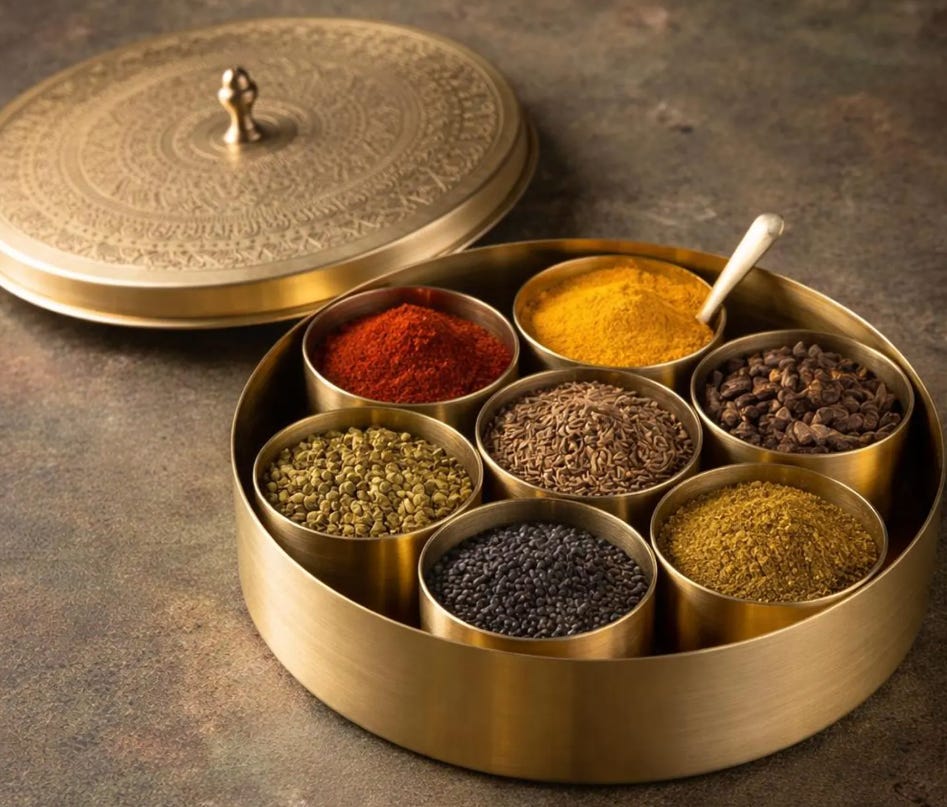
Before I reach for a knife, before onions surrender to heat, before the first sputter of tempering announces itself, my hand goes almost instinctively to the same place.
A bronze masala dabba.
Familiar, unassuming, essential.
For those unfamiliar, a masala dabba (pronounced muh-saa-laa duh-baa) is the round spice keeper found in many Indian kitchens, holding the spices most often reached for in daily cooking.
But describing it that way feels a little like calling a family photo album a paper object.
Technically accurate. Emotionally useless.
A masala dabba is not merely storage. It is instinct arranged in small metal cups, the private geography of a cook, a quiet portrait of what a household reaches for when there is no time to deliberate, only to cook.
And truthfully, a single masala dabba is only the beginning.
To imagine Indian cooking through the lens of one spice keeper is rather like imagining an orchestra through one violin. There is simply too much depth.
In my own kitchen, I keep three bronze masala dabbas in active rotation for everyday cooking alone, each with its own internal logic, each carrying a different conversation. Lift their lids and you will find not a random assortment, but a carefully considered geography of instinct. Spices chosen not merely for flavour, but for purpose, sequence, temperament, and memory.
And even those are only the opening chapter.
Beyond them stand countless glass jars in varying shapes and sizes, holding the deeper pantry. Sonth (dry ginger), kokum (Garcinia indica), til (black and white sesame), amchur (dried green mango powder), anardana (dried pomegranate seeds), kasuri methi (dried fenugreek leaves), methi dana (fenugreek seeds), poppy seeds, saffron, dry coconut, nagkesar (cobra’s saffron), pipla mool (Piper longum, long pepper root), tamarind, and enough regional dried red chilies to make the phrase chili powder feel hilariously insufficient.
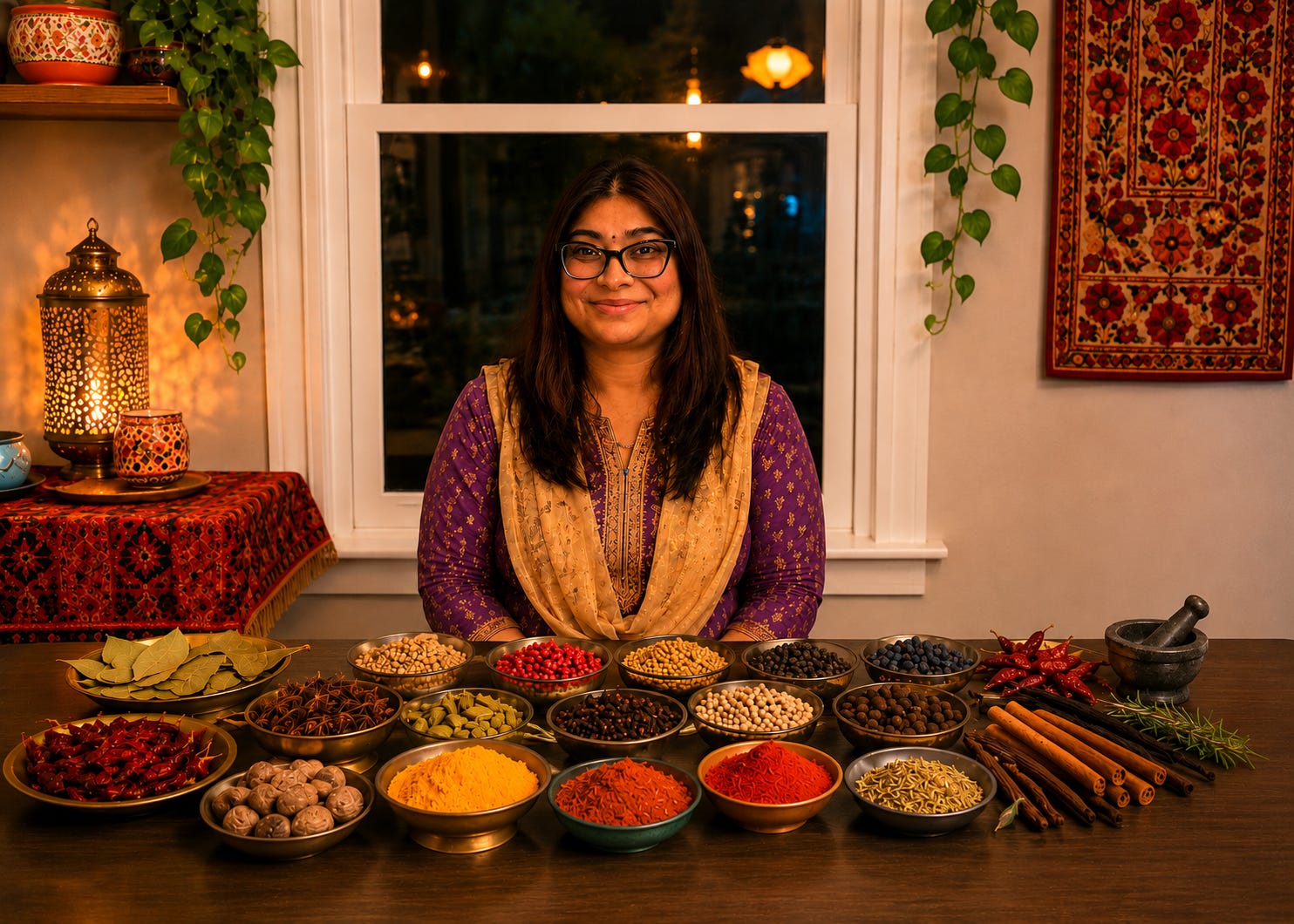
Dry or wet, spices demand respect and reverence. Not intimidation, and certainly not precious ceremony. But respect.
Because Indian cooking does not treat spices as decorative confetti to be flung about in hopeful enthusiasm.
They are architecture, structure, timing, and memory.
Some bloom in hot oil and perfume the room before the first onion softens. Some must be coaxed gently through dry heat until their deeper selves emerge. Some insist on being ground fresh. Others behave best powdered, dissolving quietly into gravies and lentils. Some ask only to be bruised lightly, just enough to release their perfume without surrendering entirely.
A spice is never merely itself. It is also form, timing, heat, restraint, and intention.
As a child, I understood the authority of a masala dabba long before I understood the mechanics of cooking.
These were not objects one idly rummaged through with careless fingers.
I learned first by observation, by scent, by sound, by the quiet choreography of women who never seemed to measure, yet somehow always knew.
A pinch here. A pause there.
The unmistakable crackle of mustard seeds announcing themselves in hot oil from another room. Cardamom pods bruised just enough to surrender their perfume. Fenugreek handled with restraint, because too much bravado would punish the dish with bitterness.
No one sat me down with a formal lecture on spice theory, though in hindsight it may have spared me a few spirited kitchen misadventures.
Instead, like so much of cultural inheritance, it arrived by osmosis.
And now I find myself on the other side of that inheritance.
Sometimes, my little one wanders into the kitchen, anklets tinkling her arrival long before I see her, drawn as children so often are to the mysterious things adults seem to handle with importance.
I watch her curious fingers hover near the masala dabbas, mesmerised by colour, fragrance, and the quiet allure of things not yet meant for small hands.
And almost instinctively, I hear myself becoming the voice that once guided me.
Not that one, little hands.
That must bloom first.
This comes later.
Even reverence, I suspect, is taught through repetition.
Because spices, in our tradition, are never merely ingredients. They are knowledge, memory, discipline, and inheritance.
This is where Indian cooking is so often misunderstood by the hurried eye.
People ask, “What spices are in this?”
Yet the better question is quieter.
In what form, at what moment, and to what end?
Whole cumin meeting hot oil is performing an entirely different act from ground cumin folded into yogurt, lentils, or chaat. One blooms through heat, darkening, deepening, perfuming the air with a nutty earthiness that announces itself almost immediately. The other settles more quietly, integrating itself rather than declaring itself.
Same spice. Entirely different conversation.
Shah jeera, finer, darker, and more elusive than everyday cumin, carries a fragrance that feels almost courtly. If cumin is the dependable neighbour who shows up when needed, shah jeera is the quietly well-dressed guest whose presence subtly alters the tone of the evening.
Mustard seeds do not believe in timid entrances. Drop them into properly heated oil and they erupt in sharp protest, a staccato chorus that tells the kitchen something has begun. I have always thought of them as impatient little heralds, unwilling to sit quietly in the wings while the rest of the dish finds itself.
Turmeric, to me, has never felt like a mere ingredient so much as a quiet inevitability. It arrives not with drama, but with authority, staining fingertips, wooden spoons, the occasional unsuspecting tea towel, and somehow, over a lifetime, memory itself. I have yet to know an Indian kitchen that treats it as optional.
Hing (asafoetida) is one of Indian cooking’s great acts of faith. In its raw form, it is unapologetically pungent, almost confrontational to the uninitiated, the sort of aroma that makes newcomers question your judgment entirely. It is also the eccentric aunt of the spice world, impossible to explain gracefully, slightly alarming at first encounter, and yet somehow indispensable to family life. In the hands of heat and timing, it transforms into something quietly essential.
It asks for trust, and perhaps even more than that, experience.
And then there are the souring agents, which to call simply sour feels almost offensively reductive.
Indian kitchens have never relied on acidity as a one-note instrument.
Sourness, too, has lineage, geography, temperament, and purpose.
Amchur carries the dry brightness of green mango without introducing moisture. Anardana brings tartness, yes, but with fruit still clinging to its memory. Kokum tastes of India’s western coastal kitchens and darker moods, its acidity gentler, more brooding. Tamarind is lush by comparison, generous but fully capable of commandeering the conversation if not handled with a steady hand.
To call them all simply sour is rather like calling all music sound.
And chilies deserve their own chapter entirely.
To say red chili in Indian cooking is rather like saying wine and expecting that to suffice.
Kashmiri for colour and gentler warmth. Byadgi for depth. Guntur for unapologetic fire and absolutely no interest in diplomacy. Mathania carrying the sun-baked confidence of Rajasthan.
Each region keeps its loyalties, its tolerances, and its negotiations with heat.
Red chili is temperament in powdered form.
The art, of course, lies in knowing whether the day calls for persuasion or provocation.
And perhaps this is why I bristle, ever so slightly, when someone asks, “So what spice do you add?”
What spice.
As though Indian cooking were waiting for a singular heroic ingredient to sweep in wearing a cape.
No.
Indian cooking is not built around singular heroics. It is ensemble work, conversation, negotiation, sometimes argument, certainly hierarchy, and always timing.
A masala dabba does not hold ingredients.
It holds decisions.
And I suspect migration sharpens one’s understanding of this, because moving through life, and especially across continents, teaches you rather quickly to distinguish between what is decorative and what is essential. When kitchens change, grocery aisles become foreign, and familiar ingredients hide beneath unfamiliar labels, you begin to understand what steadies you. What anchors flavour. What quietly says home.
And lest you imagine all this complexity belongs only to the savoury realm, our sweets would strongly disagree.
Gulab jamuns, those syrup-soaked orbs of unapologetic joy, may be indulgent, but Indian kitchens have never had much patience for sweetness that behaves predictably or leaves without leaving an impression.
Cardamom, saffron, sometimes rose, and occasionally black pepper in older traditions, arriving with quiet mischief.
Saffron, when treated properly, is not merely colour. It is ceremony, reverence, an offering. One does not simply fling saffron into a pot with the abandon of confetti at a wedding where no one likes the groom and expect transcendence.
It asks to be warmed, bruised gently, persuaded into surrender.
Black pepper, meanwhile, is a delightful trickster, appearing where sweetness has grown perhaps a touch too comfortable with itself. Dry coconut lends warmth and body. Poppy seeds soften into silk. Til crosses effortlessly between temple offerings, festive sweets, and everyday comfort.
Even our desserts insist on character.
No two masala dabbas tell precisely the same story.
Some keep fennel close. Some insist on ajwain (carom seeds). Some are immaculate little universes. Others are gloriously lived in, stained with turmeric, fragrant with cumin, marked by years of meals, improvisations, and the occasional culinary near-disaster.
Mine, I suspect, reveal both appetite and temperament.
A masala dabba is less a spice keeper than a portrait of a kitchen in motion.
And perhaps that is why I love them so fiercely.
Because before the dish becomes visible, before anyone tastes, before compliments or criticism or second helpings, there is this private beginning.
The hand reaching. The lid lifting. The fragrance rising. The cook deciding.
Whole?
Powdered?
Bruised?
Bloomed?
Steeped?
A pinch?
A spoon?
A memory?
And if the dry pantry teaches discipline, the wet pantry teaches temperament.
Because spices, for all their architecture and memory, do not cook alone. They wait for their living companions.
The onion that softens into foundation.
Ginger that announces intent.
Garlic with absolutely no interest in subtlety.
Tomatoes forever negotiating between acidity and sweetness.
Green chilies, all mood and mischief.
Curry leaves that arrive in hot oil like applause.
Fresh coriander, bright and fleeting.
Coconut in its many mercurial forms.
That, however, is another conversation entirely.
And, I suspect, a glorious one.
Because if the masala dabba is the quiet mind of an Indian kitchen, the wet pantry is its pulse, where memory arranged in bronze learns to move. And pulse, I have come to believe, has a language all its own. Perhaps that is where our next conversation begins to blossom.
- "Turmeric, to me, has never felt like a mere ingredient so much as a quiet inevitability."
- "The wet pantry is its pulse, where memory arranged in bronze learns to move."
- "Red chili is temperament in powdered form."
There is so much poetry in this post! (I could list many, many examples; the three above particularly stood out for me.)
My wager: you may not feel it yet, but - post by post - you are writing a most interesting & incredible book. 😉