
Steel Has No Time for Drama
On stainless steel, unsentimental grace, and the vessels that stay when life gets loud

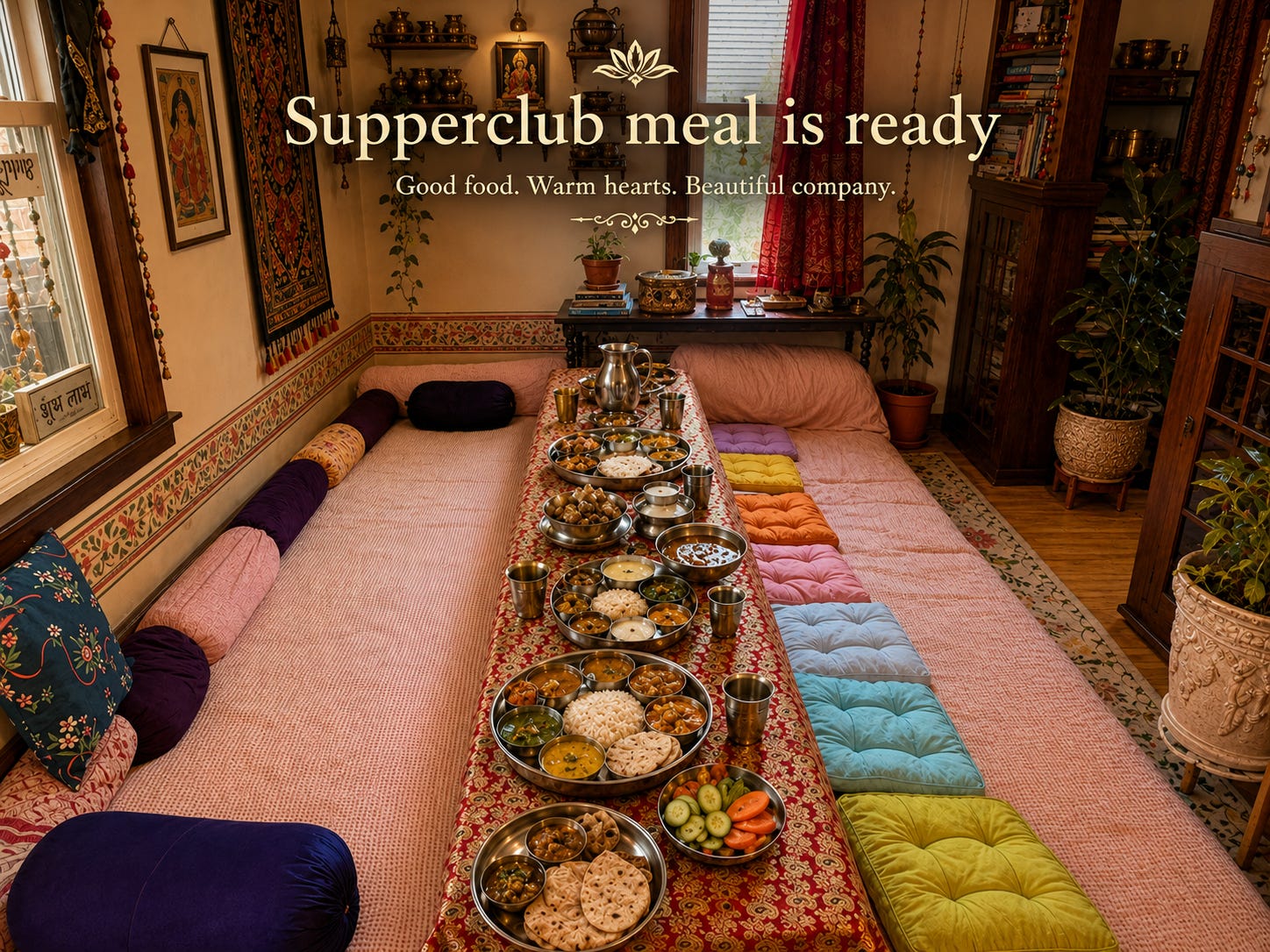
Stainless steel does not enter the kitchen looking for poetry.
It has work to do.
This, I suspect, is why it has survived nearly every Indian household with such calm authority. Clay remembers. Iron answers. Bronze keeps the table. Copper arrives glowing, misbehaving, and demanding a polishing cloth before breakfast.
Steel is already on the table, holding the meal.
Steel has no time for this drama.
It has held yesterday’s dal, tomorrow’s dough, the child’s lunch, the traveller’s tea, the temple’s prasad, the train station’s water, the hostel student’s entire emotional support system, and that one mysterious leftover everyone keeps moving around the fridge because no one wants to take responsibility for it.
Steel does not complain.
It stacks.
It clangs.
It survives.
Sometimes it falls from a shelf with the full theatrical confidence of a small avalanche and still emerges looking more offended than injured.
That, too, is character.
Steel appears in the kitchen drawer as spoons, in the cupboard as plates, in the lunch bag as tiffins, in the pressure cooker as weekday salvation, in the langar hall as service made visible, and in the immigrant apartment as proof that a kitchen can begin again with very little ceremony.
This is not the vessel we romanticise first.
Uncelebrated steel.
No one writes sonnets to a stack of stainless-steel plates.
No one gazes at a dabba and whispers, “Ah, ancestral longing.”
No one places a stainless-steel katori in a shaft of afternoon light and says, “Come, children, behold your inheritance.”
Poor steel.
It has spent generations doing the work while copper gets the compliments.
And yet, if the Indian kitchen had to choose one material to get through an ordinary week, steel would quietly raise its hand.
Steel does not believe in raising its hand dramatically.
It would simply be there, already washed, already waiting, slightly scratched, entirely useful, and probably holding something important.
That is steel’s beauty.
It does not try to look ancient. It does not need to glow like copper, darken like iron, breathe like clay, or gleam with the old dignity of bronze. Steel’s grace is practical, repeatable, democratic, and deeply unsentimental.
Which is to say, it may be one of the most honest vessels we have.
Stainless steel belongs to the weekday.
To the school morning.
To the office lunch.
To the train journey.
To the kitchen where everyone is tired and someone still has to pack food.
To the house where leftovers are not shame, but tomorrow’s lunch wearing a different name.
To the fridge shelf where five steel bowls sit under plates, because apparently matching lids are a myth told to young brides to keep hope alive.
To the diaspora kitchen where a pressure cooker, three steel bowls, one thali, a dabba set, and a decent spoon can make a foreign apartment feel less like temporary shelter and more like the beginning of a household.
Steel understands beginnings.
Not the cinematic kind where curtains billow and ancestral music rises.
The other kind.
The kind where you have just moved, the boxes are still sulking in corners, the good knives are missing, no one knows where the masalas went, and somehow dinner must still happen.
Steel is excellent in such moments.
It does not ask whether the kitchen has found its soul yet.
It simply holds the rice.
That, too, is a kind of grace.
Not the graceful grace of poetry, perhaps, but the grace of someone who arrives early, stays late, and does not require emotional processing before doing the work.
Someone in every family seems to carry this gift.
Steel is that presence in the kitchen.
The one that does not ask for a garland.
The one that has already washed the cups.
And nowhere does steel reveal itself more clearly than in service.
Not display.
Not performance.
Service.
The kind that does not pause to admire its own reflection because someone is hungry and the dal is ready.
In a langar hall, steel slips beyond itself.
Plates move from hand to hand, filled, emptied, washed, returned. The rhythm is so constant it stops feeling like labour and begins to feel like prayer.
There is music there.
Not delicate music.
Steel is not a sitar being tuned by moonlight.
Steel is percussion.
The clatter of thalis.
The bright knock of katoris.
The metallic rain of spoons being gathered into deep tubs.
The great democratic thunder of many people being fed without anyone needing to announce themselves as special.
A steel plate does not ask who you are before receiving food.
It does not care whether you arrived in silk, denim, uniform, work boots, grief, hunger, exhaustion, devotion, curiosity, or the mild confusion of someone who followed the crowd and is now holding a plate.
Steel receives.
Again and again.
In langar, this matters.
The vessel does not elevate one person above another. It does not reserve its shine for the wealthy, the learned, the powerful, or the polished. It sits in the hands of the labourer, the grandmother, the student, the businessman, the child, the traveller, the widow, the volunteer, the stranger.
Same steel.
Same dal.
Same floor.
Same invitation.
There is a theology in that, though steel would never be vulgar enough to say so.
Steel is too busy being washed.
This is why I trust it.
Steel understands that dignity does not always arrive dressed in grandeur. Sometimes dignity arrives in a dented thali that has fed thousands. Sometimes it arrives in a tumbler passed from one hand to another. Sometimes it arrives in a volunteer scrubbing plates until the wrists ache and the heart, mysteriously, feels lighter.
There are vessels that teach refinement.
There are vessels that teach caution.
There are vessels that teach memory.
Steel teaches participation.
It says, come, eat.
Then, with absolute practicality, it says, now wash.
How Indian.
How spiritually inconvenient.
Because we are all very fond of being served until it is time to help clear the plates.
Steel has witnessed this about humanity and chosen discretion.
It has watched entire households develop urgent phone calls immediately after dinner. It has endured the mysterious disappearance of children when plates must be cleared. It has heard the phrase “I was just about to help” more often than any material should have to.
It has seen uncles drift toward the veranda.
It has seen teenagers vanish into homework they were not previously interested in.
It has seen guests suddenly become deeply involved in locating their shawls.
Steel has seen everything.
And still, it stays.
The plate that held the food waits to be rinsed, dried, stacked, and returned to readiness. The meal is complete not only when we finish eating, but when the vessel is prepared for the next hungry hand.
This is perhaps steel’s finest wisdom.
The receiving is not separate from the serving.
The full stomach is not separate from the hand that returns the plate to use.
Steel moves through the whole cycle without becoming precious about any one part of it.
A polished copper vessel may announce care.
A bronze bowl may carry old dignity.
An iron tawa may hold the memory of heat.
Steel, meanwhile, gets on with the work.
It feeds crowds.
It survives constant handling.
It stacks neatly when the meal is over.
It returns tomorrow ready to do exactly the same thing, which is more than can be said for most of us before our first cup of tea.
Reliability is easy to overlook because reliability rarely asks to be noticed. We photograph the beautiful. We preserve the rare. We admire the exceptional.
But most lives are sustained by what is dependable.
The vessel that is always there.
The plate that can be used by anyone.
The tumbler that passes from hand to hand.
The bowl that asks for neither admiration nor apology.
A steel plate in a community kitchen tells that story particularly well.
Not a story about scarcity.
Not even a story about efficiency.
A story about continuity.
About making sure the next person can be fed.
And the person after that.
And then whoever comes next.
Steel understands repetition without resentment.
Which may be why it has become one of the great materials of everyday care.
Not glamorous care.
Not ceremonial care.
The ordinary kind.
The kind that keeps showing up.
The kind that quietly holds a meal, a household, a community, and sometimes a tradition together.
And perhaps this is why steel deserves its own place in the old procession.
Clay remembered first.
Iron answered back.
Bronze kept the table.
Copper misbehaved beautifully.
And steel, faithful steel, stayed.
Not at the centre of the room demanding reverence.
Not glowing from a shelf.
Not waiting to be polished into importance.
It stayed where life needed it most.
Beside the stove.
Inside the lunch bag.
On the floor of the langar hall.
In the sink after the meal.
In the hands of the one who served.
In the hands of the one who washed.
In the hands of the next person waiting to be fed.
This is not a small inheritance.
It is easy to mistake grandeur for shine. Steel knows better. It has carried the quieter grandeur of usefulness, the daily nobility of service, the unsentimental tenderness of returning again and again to the work.
It has carried our meals.
It has carried our hurry.
It has carried our migrations, our leftovers, our school mornings, our temple kitchens, our tired evenings, our first apartments, our community tables, and our ordinary hunger.
Steel has no time for drama.
And perhaps that is why, in the end, it has carried so much of ours.
Steel to me is the 50 year old wedding gifts (plates, glasses) with the name of the wedding couple tattooed on them :) and still going strong, just like the couple!
- "The kind where you have just moved, the boxes are still sulking in corners."
This is evokes *such* a precise feeling of a very specific phase in a move. Well done.
- "Reliability is easy to overlook because reliability rarely asks to be noticed. We photograph the beautiful. We preserve the rare. We admire the exceptional."
Well noticed, well said. I feel at ease with steel, and your essay explains why.
Thank you!