
Iron Answers Back
On tawas, kadais, seasoning, strength, and the authority earned through use

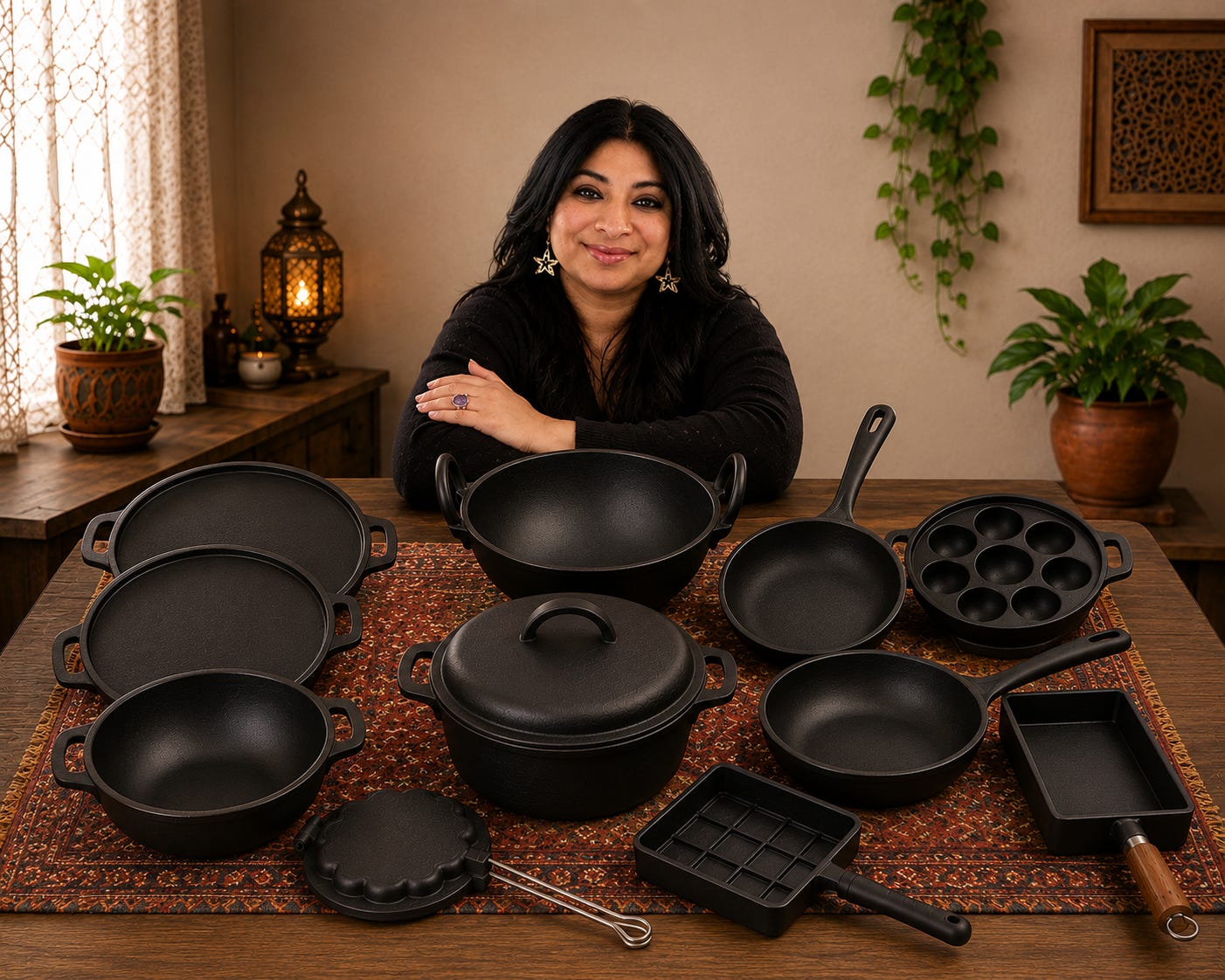
Iron does not enter the kitchen quietly.
Even when it is silent, it has weight.
A good iron tawa sits on the stove with the calm confidence of someone who has heard all the arguments before and does not intend to repeat herself. It does not sparkle. It does not flatter. It does not promise effortless release in twelve languages on a cardboard sleeve.
It simply waits for heat.
And once heat arrives, iron becomes very clear about things.
Too soon, and the food meets an unready surface. Too late, and it protests. Too little oil, and whatever you are making attaches itself to the pan with the legal determination of ancestral property. Too much impatience, and breakfast begins revealing weaknesses in your character that you had hoped to address privately.
Iron is not cruel.
It is honest.
This is why I love it.
And also why, on certain mornings, I have had private arguments with it.
Clay, in the previous essay, taught me something about rest. About coolness. About what happens when a vessel knows how to wait without making a performance of its patience.
Iron is different.
Iron is not waiting for anyone to become poetic.
Iron wants you present. It wants the flame right, the hand steady, the attention honest. It has no interest in your excuses, which is unfortunate, because I usually have several ready.
This may be why iron has always felt so familiar to me.
There is something in its temperament I recognise.
My life has been nomadic in a way I did not exactly choose. Not the glamorous kind, let us be clear. No flowing linen, no tasteful leather journal, no sunlit photograph captioned “new beginnings.” More the other kind. The kind where life looks at you every few years and says, “Right, pack what you can. Leave what you love. We have to go.”
Very rude of life, honestly.
And each time, the kitchen becomes the hardest room.
Clothes can be reduced. Books can be argued over. Papers can be shoved into folders with the false confidence of people who believe they will remember where they put things. But a kitchen asks more personal questions.
What has fed you?
What has held your hand through ordinary days?
What object has become less object and more witness?
That is where iron always breaks my heart a little.
Because iron is heavy.
Faithful, yes. Magnificent, yes. Emotionally significant beyond what is reasonable for cookware, also yes.
But heavy.
And in the cruel court of luggage allowance, sentiment is rarely granted full legal standing.
So, many times, my faithful iron has gone to the little sacrificial altar of migration.
Not an ancient stone altar under a blood-red moon, though emotionally, let us be honest, it has occasionally felt close. More often it has been a folding table in a driveway, a cardboard box near the door, a donation pile, a yard sale, some terribly practical corner where beloved objects are asked to behave like ordinary things.
There lies the iron.
Too heavy for this move.
Too impractical for this season.
Too much for this box, this shipment, this continent, this version of survival.
One pan at a time, one tawa at a time, one faithful blackened companion at a time, it has submitted to the ceremony.
And I, ridiculous high priestess of emotional cookware, have stood there pretending to be normal.
The buyer is delighted.
I am trying to look composed.
Inside, however, a small orchestra has begun.
I tell them, perhaps too earnestly, “This is a good pan.”
Then, because grief has apparently removed all sense of proportion, I begin explaining its life story. How many beautiful things it has cooked. How well it holds heat. How it has nourished my family. How it must be dried properly. How a little oil after washing will keep it happy. How it may look simple, but it is not ordinary.
At this point, the person may only have come for a bargain.
They were not expecting a blessing ceremony.
Still, I continue.
Because some things deserve to be sent off properly.
I wish the pan well. I silently request that it behave kindly in its new home. I hope it will feed that family as generously as it fed mine. I imagine it entering another kitchen, another rhythm, another set of hands, and I comfort myself with the thought that perhaps this is not an ending.
Perhaps this is iron doing what iron does.
Returning to service.
Changing households.
Carrying memory without needing to keep the same address.
A good iron tawa or kadai is not easy to leave behind. Once it has known your oil, your flame, your mornings, your mistakes, it does not feel replaceable. It feels like a relationship interrupted mid-sentence.
Still, iron has never scolded me for leaving.
At least not aloud.
I imagine it consoling me with the grave tenderness of an old lover who understands time better than I do.
Do not worry.
In another home, on another stove, in another country, in another form, we will meet again.
And somehow, we do.
Time and time again, iron reincarnates in my life.
A different tawa. A different kadai. A different weight in the hand. A new surface to season, coax, argue with, and eventually trust. It finds its way back into my kitchen as though destiny itself has a fondness for well-tempered cookware.
This may sound dramatic.
Good.
Iron deserves drama.
Not the fragile drama of things that need constant praise, but the deep, stubborn drama of reunion. The kind that says, we have lost each other before, and we know how to begin again.
There is comfort in that.
If an ancient metal can keep returning across homes, seasons, continents, and all the absurd rearrangements of life, perhaps we too can learn something from it. Perhaps relationships are not always preserved by never being interrupted. Perhaps some bonds survive through return, through re-seasoning, through heat, through forgiveness, through the willingness to meet again in a changed form and still say, yes, I know you.
Iron teaches this without sentimentality.
It does not weep at airports.
It simply waits to be found again.
And once found, iron does not become intimate immediately.
Iron is not the sort of companion that collapses into your arms on the first day and says, “Where have you been all my life?” Iron is more dignified than that. Also more suspicious.
A new iron tawa arrives with possibility, certainly. But possibility is not authority. Authority must be built.
Oil by oil.
Flame by flame.
Meal by meal.
This is where seasoning begins.
And seasoning, in the matter of iron, is one of the most misunderstood words in the modern kitchen. It is not flavouring, not exactly. It is not decoration. It is not some mysterious black magic performed by people who own too many kitchen towels and speak in frighteningly confident tones about smoke points.
Seasoning is relationship made visible.
A thin layer of oil meets heat. Then another. Then another. Food comes and goes. Mistakes happen. Something sticks. Something releases. Someone forgets to dry the pan properly and later discovers that iron, like many elders, remembers neglect with impressive accuracy.
A seasoned iron surface is not dirty.
It is initiated.
This matters because modern cleanliness has taught many people to fear anything that looks like use. We have been trained to admire the spotless, the untouched, the factory-new surface shining with the sterile innocence of a thing that has never had to feed anyone.
Iron disagrees.
Iron becomes trustworthy by being used. Its darkness is not failure. Its unevenness is not shame. Its surface, built slowly through heat, oil, patience, and correction, is a record of meals.
A good iron tawa does not become beloved because it stayed perfect.
It becomes beloved because it stayed.
This is why the household drama around washing iron is not entirely absurd, though outsiders may disagree. There are homes where touching the old tawa with soap is not exactly a crime, but it is certainly the sort of event after which people begin speaking in wounded tones from the next room.
“Who washed this?”
Such a small question.
Such a large silence.
Someone will say, “I only cleaned it properly.”
Properly.
At this point, the ancestors sit up.
Because the one who says “properly” usually means well, and this is often where trouble begins. Many catastrophes in Indian kitchens have begun with someone meaning well.
Iron does not ask to be scrubbed into forgetfulness. It asks to be cleaned with understanding. Wiped. Rinsed when needed. Dried well. Oiled lightly. Returned to readiness.
There is nothing glamorous about this.
That is precisely the point.
Iron teaches maintenance. Not the thrilling first purchase. Not the beautiful photograph. Not the excitement of bringing home something new and imagining one’s entire life improved by Friday.
Maintenance.
The humble, repetitive, deeply unromantic labour by which useful things become faithful.
The tawa is perhaps iron’s most intimate form in the Indian kitchen because it lives so close to the ordinary.
Not the dramatic ordinary either. The real one.
The morning where everyone is slightly late. The lunch where the dough is drier than expected. The evening where someone has asked for “just one small roti,” a phrase that has never once meant one small roti in the history of Indian households.
The tawa knows these negotiations.
It knows the first one made to test the heat, the one that becomes cook’s tax, child’s snack, or quiet evidence that the flame needs adjusting. It knows the roti that puffs magnificently when no guest is watching and then behaves like a folded legal document the moment one wishes to impress someone.
This too is part of its authority.
Iron does not merely cook the daily.
It witnesses the daily without allowing it to become small.
The kadai carries another side of iron’s temperament.
If the tawa is intimate, the kadai is communal. Deeper, rounder, more dramatic by design. It is the place where sabzi gathers, where tadka becomes fragrant, where pakoras descend with optimism, where pooris swell into brief golden confidence before collapsing into the reality of being eaten.
A good iron kadai understands abundance.
It knows that Indian cooking is rarely content with one quiet layer of flavour. Naturally not. We prefer things to arrive with witnesses. Cumin crackles, mustard seeds jump, curry leaves enter like they have been waiting for their cue, onions soften, spices darken, vegetables surrender, and somewhere nearby someone asks, “Is it ready?” at exactly the wrong time.
Iron does not answer that person.
Iron is busy.
In a kadai, food does not merely cook. It gathers momentum. Heat curves around the food. Oil moves differently. Spices meet surface and bloom with a seriousness that reminds you why shortcuts, though sometimes necessary, are not always innocent.
There is another old wisdom here too, one our elders often carried without needing to name it in the language we use now.
Today, deficiency has become a household genre of its own.
Iron levels. Vitamin levels. Supplements. Blood tests. Capsules lined up beside the kettle like a tiny pharmaceutical army. We have words now for tiredness, depletion, anaemia, absorption, minerals, and all the invisible shortages the body can carry quietly for years.
Our grandmothers may not always have spoken in that vocabulary.
But they were not foolish.
They knew that the vessel mattered.
Not only what was cooked, but what it was cooked in. Not only the ingredient, but the surface it touched. A meal made in iron was not discussed like a prescription, and it should not be romanticised as a cure. But there was an understanding, subtle and practical, that the kitchen could support the body through small, repeated choices.
A little more attention here.
A better vessel there.
Food that met iron, sourness that pulled something from the pan, daily cooking that offered nourishment not as a dramatic intervention, but as quiet accumulation.
This is the kind of wisdom modern life often forgets because it arrives without packaging.
No label.
No dosage.
No promise printed in bold.
Just a pan on the stove, darkened by use, doing its ordinary work.
And perhaps that is the point. Some nourishment does not announce itself as wellness. It enters through habit. Through the humble intelligence of what we cook, how we cook, and what we allow our food to meet before it reaches the body.
This is not to shame the modern pan.
The modern pan has its place. It is light, agreeable, easy to clean, and often emotionally uncomplicated. There are days when that is exactly what life requires. No one should be asked to prove devotion to heritage while also dealing with homework, emails, laundry, and the mysterious disappearance of every matching container lid.
But iron brings something else.
A certain gravity.
You feel it in the arm first. Iron has no interest in pretending to be light. Lifting a full iron kadai is not cooking. It is upper-body training with onions. The wrist learns respect. The forearm receives information. The cook becomes aware, very quickly, that materials have consequences.
And yet, that weight is part of its promise.
Iron stays steady. It holds heat with conviction. It does not flutter at every change. Once warmed, it carries itself with the confidence of something that knows both endurance and appetite.
Perhaps that is why food cooked on iron can feel so deeply satisfying.
Not because iron is magical, though some old tawas make a persuasive case.
Because iron has no patience for half-heartedness.
It asks the cook to stay present through the small thresholds. The moment before sticking becomes release. The moment before browning becomes burning. The moment before confidence becomes arrogance, which is a dangerous moment in any kitchen and, frankly, in life.
Iron teaches through these thresholds.
It does not give all its answers at once. It gives them in tiny permissions, earned through attention.
This is why iron belongs so deeply in a kitchen built around inheritance. It teaches that care does not always look soft. Sometimes care looks like drying the pan before bed. Sometimes it looks like rubbing oil into a dark surface. Sometimes it looks like telling a well-meaning guest, with great politeness and the force of several generations behind your eyes, “Please leave that tawa. I will wash it.”
Which, in Indian, means step away from the ancestral surface before I lose my composure.
Iron teaches boundaries.
A useful lesson, in cookware and otherwise.
It teaches that not everything can be handed to everyone without instruction. Not because we are possessive, though let us not deny the evidence entirely, but because some things carry histories that must be handled with care.
A seasoned tawa is not precious because it is fragile.
It is precious because it has become specific.
Specific to the hand. Specific to the stove. Specific to the flame, the timing, the way a household eats. This is why replacing it is never as simple as buying another pan. Of course, another pan can be bought. The market is full of confident pans. They stand in rows, gleaming and available, each claiming to be the answer to a question no one’s grandmother asked.
But a known iron tawa is not replaced.
It is mourned briefly, dramatically, and then, if life insists, begun again.
That beginning again matters.
A new iron pan asks us not to despair over what was lost, but to enter the relationship from the first layer. To heat, oil, wipe, cook, fail, adjust, cook again. To accept that authority can be rebuilt. That trust can return. That the first few attempts may be awkward, but awkwardness is not failure. It is simply the early stage of belonging.
Iron knows this.
Perhaps that is why it keeps finding me. Or I keep finding it. At some point, in a relationship this old and slightly melodramatic, assigning responsibility feels unwise.
What I know is this.
Wherever I go, I look for iron.
Not immediately, perhaps. There are always other emergencies. Groceries. Schools. Documents. The strange local logic of light switches. The first week in a new place is rarely poetic. It is usually held together by toast, confusion, and one overused saucepan.
But eventually, I begin searching.
A tawa. A kadai. Something with weight. Something that will not flatter me. Something that will make me earn my food honestly.
And when iron returns to my kitchen, the place begins to feel less temporary.
Not complete.
Not settled in the grand sense.
But less like a station.
More like a hearth beginning to remember itself.
There is something merciful in iron.
So much of modern life asks us to remain new-looking. Polished. Efficient. Unscarred. As though usefulness should leave no mark. As though service should not alter us. As though the evidence of having fed, carried, endured, moved, lost, returned, and begun again should be hidden before anyone sees.
Iron refuses this vanity.
It does not apologise for its darkening.
It does not disguise its history.
It does not become valuable by escaping use. It becomes valuable because of use.
What a radical teaching.
And what a tender one, though iron would likely object to being called tender. It has a reputation to maintain.
Still, tenderness is there.
Not the softness of clay. Not the cool hand on the forehead. Iron’s tenderness is sterner. It says, I will hold heat for you. I will steady the daily meal. I will ask you to pay attention. I will not flatter your carelessness, but I will reward your return.
That, to me, is love of a very old kind.
Not sentimental.
Faithful.
Clay remembered first.
Iron answers back.
And after the answer, after the heat, after the food has met flame and the kitchen has filled with the smell of work becoming nourishment, another kind of vessel waits.
A vessel for the table.
For serving.
For receiving.
For the moment when food leaves labour and becomes offering.
Bronze is waiting there.
Quietly gleaming.
Not soft.
Not loud.
But present, the way old dignity often is.
Very useful information what is the use of iron tawa our great grand parents know the worth.
Hi again, here's some of what really caught my attention:
- "Some terribly practical corner where beloved objects are asked to behave like ordinary things."
Oh how well I know this feeling, (after so many moves). Your description feels so apt.
- "ridiculous high priestess of emotional cookware" gave me a chuckle that transitioned to deep fondness (for you).
- "Perhaps some bonds survive through return, through re-seasoning, through heat, through forgiveness, through the willingness to meet again in a changed form and still say, yes, I know you."
So hopeful. May we all be so blessed.
- I highly appreciate this definition of maintenance: "the humble, repetitive, deeply unromantic labour by which useful things become faithful."
Frankly, I'd like to see a complete Chef Daljeet Glossary one day!
- "upper-body training with onions" gave me another chuckle moment.
- "Awkwardness is not failure. It is simply the early stage of belonging."
Another potential fantastic addition to the Glossary. ;)
- "So much of modern life asks us to remain new-looking [...] As though usefulness should leave no mark. As though service should not alter us."
So true. It's quite insulting when one stops to think about it, that somehow our bodies ought to retain characteristics of babies and/or children and/or young adults when we are anything but. Thanks for helping me stop to think about it.