
Copper Misbehaves Beautifully
On tamra, tamba, glow, temptation, water, caution, and the metal Indian kitchens keep losing and finding again

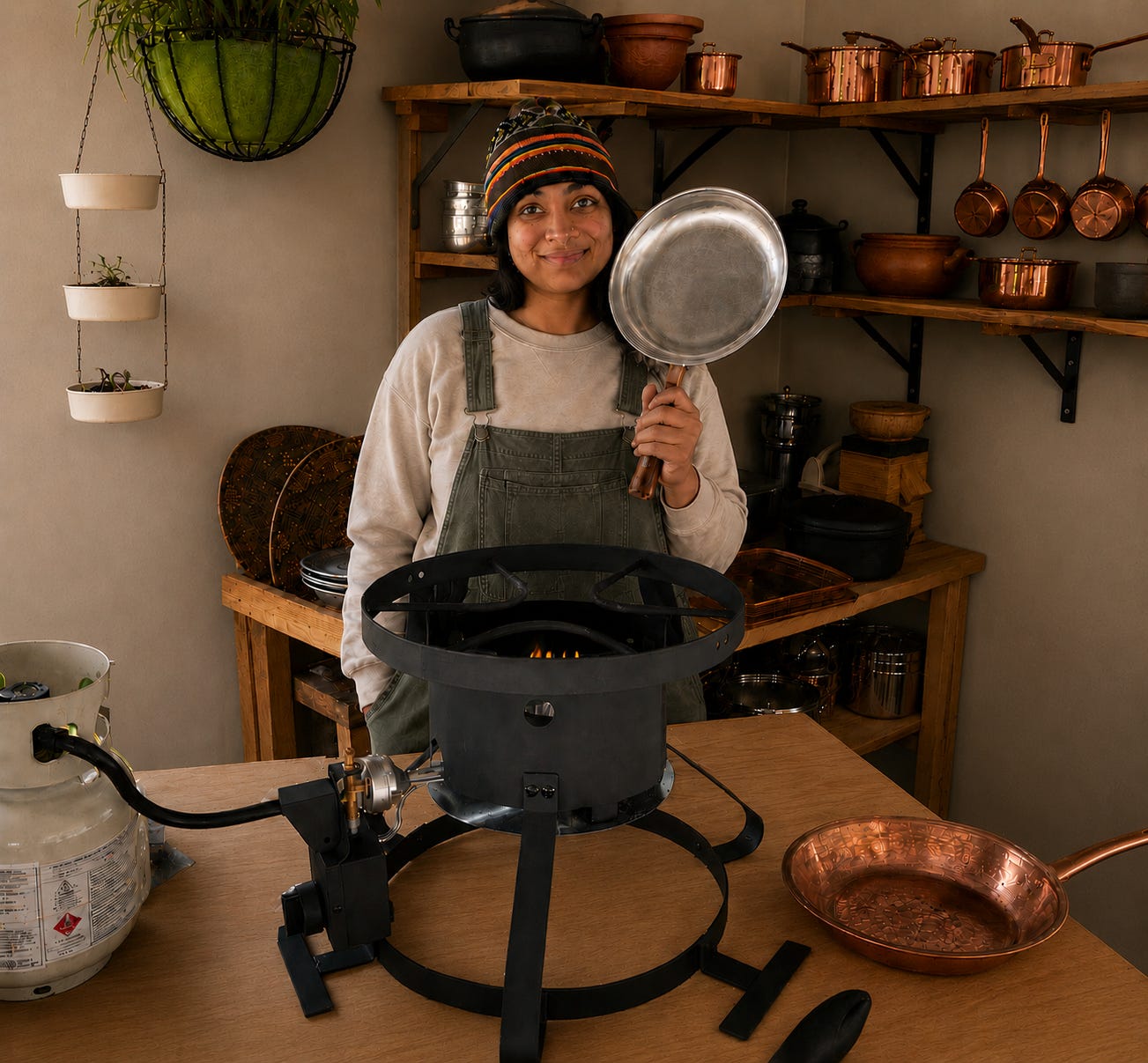
Copper enters the kitchen like light with an agenda.
It does not simply sit on a shelf. It catches.
One small slant of afternoon sun and there it is, glowing as if the entire household has been waiting for its arrival and should perhaps apologise for not polishing sooner.
Clay never behaved like this.
Iron had no interest in being admired.
Bronze carried itself with old nobility.
Copper, however, has performance in its bloodstream.
It is not “Oh, this old thing?” beautiful. It is “Yes, this old thing, and please notice properly” beautiful. It warms the eye before it ever touches water or flame. It makes even an ordinary corner look as though someone’s grandmother might appear there at any moment, carrying instructions, turmeric, and a mild judgement about the state of the household.
Copper knows we are vulnerable to this.
It knows the human heart is easily defeated by glow.
It knows that a perfectly sensible person can look at a copper vessel and suddenly begin saying irresponsible things like, “This is not shopping, this is cultural restoration,” while the bank account quietly reaches for smelling salts.
Copper has always known how to get in.
Long before copper bottles began standing on modern countertops beside yoga mats, chia seeds, lemon water, and the private ambition to become a better person by 6 a.m., copper had already found its way into the subcontinent’s hands.
It came first from the earth, but not in a ready-to-use mood.
Copper had to be discovered, coaxed, heated, hammered, bent, tested, polished, and persuaded. Fire had to enter the conversation. Hands had to learn patience. Someone had to look at stone and soil and realise that buried inside the ordinary world was a material with colour, warmth, and possibilities.
Imagine the first astonishment of it.
Clay had its memory. Wood had its grain. Stone had its weight. Then copper appeared with colour in its cheeks, willing to be shaped, bright enough to feel almost alive, and flexible enough to make human beings immediately lose restraint.
Naturally, they put it everywhere.
In tools, ornaments, vessels, ritual objects, water pots, cooking pots, temple offerings, dowry trunks, storerooms, trade routes, healing traditions, and all those domestic corners where utility and reputation have always smiled politely at one another.
Because one cannot discover a metal that looks like captured afternoon and then behave with moderation.
Someone had to hammer it into a lota.
Someone had to place it beside the shrine.
Someone had to cook in it.
Someone had to polish it before guests arrived, because apparently guests cannot drink water unless the vessel has first been made to shine like moral achievement.
Someone had to say, “Bring out the copper one,” in that tone that tells the household ordinary standards have been suspended and public honour is now involved.
This is how copper entered the Indian kitchen.
Not only as a utensil.
As glow.
As ritual.
As water.
As reputation with a rounded belly and a narrow neck.
In Indian life, the kitchen, prayer room, courtyard, bathing space, and threshold have never been entirely separate territories. They borrow from each other constantly. Water travels through them. Fire travels through them. Hands travel through them. Instructions travel through them too, usually from someone sitting in another room who is not doing the work but remains spiritually committed to supervision.
Copper moved easily through that world.
The tamra lota knew the morning.
It knew the sleepy hand reaching for water before the first proper thought had formed. It knew the shrine before incense. It knew rinsing, offering, sipping, pouring, washing. It knew the courtyard. It knew the well. It knew the bathroom corner. It knew the grandmother who could hear, from three rooms away, whether water was being poured correctly.
There is always a correct way.
Indian households run on this principle.
There is a correct way to fold cloth, rinse rice, store pickle, temper cumin, cut mango, enter a kitchen, leave a kitchen, speak to elders, ignore unsolicited advice, and apparently pour water from copper without behaving like a goat recently introduced to civilisation.
Nobody gives you all the rules at once.
That would be too kind.
Instead, the rules emerge one by one, usually at the exact moment you are doing something wrong in front of witnesses.
This is how copper became intimate. Not because it was grand, though it could be grand when polished and placed with ceremony. It became intimate because it passed through the ordinary day. It touched water before food. It stood near prayer without leaving the kitchen. It entered the hand often enough to become familiar, and the eye often enough to become beloved.
Copper belonged to the daily choreography of living.
It was there when the house woke.
It was there when hands washed.
It was there when water was offered.
It was there when someone shouted, “Who moved the lota?” with the seriousness of a small constitutional crisis.
This is copper’s gift. It makes the ordinary feel attended to.
This is also copper’s trick. It makes us believe beauty will do the work for us.
It will not.
Copper is not a lazy beauty. Copper is not a soft-focus photograph one can admire and forget. Copper is beauty with a maintenance clause.
It wants to be polished.
It wants to be understood.
It wants to be used with sense.
It wants, above all, for no one to pour tamarind into it while announcing, “It should be fine.”
There is always someone who says this.
This person is dangerous.
Not wicked. Just confident in the way that causes utensils to suffer.
Copper has no patience for such optimism.
Copper is the auntie of metals.
Not the gentle auntie who simply says, “Eat more, beta,” while placing another roti on your plate.
Copper is the auntie who arrives glowing, receives compliments as though they were delayed payments, notices the one unpolished corner, asks why you look tired, blesses you, corrects your posture, questions your judgement, and still sends you home with food.
She is generous.
She is beautiful.
She is not low maintenance.
She has standards, and frankly, she is not sorry about them.
Copper will hold your water, brighten your shelf, bless your ritual, warm your kitchen, and then, with one raised eyebrow, remind you that carelessness is not a modern value. It is just carelessness wearing new clothes.
This is where the comedy begins.
Copper seduces first and gives instructions later.
It gleams like poetry, then quietly announces that sour foods require caution, lining has meaning, kalai is not decorative, neglect leaves marks, and the phrase “but I saw it online” has never saved anyone’s chutney.
Copper does not shout.
It changes colour.
That is worse.
A shouting vessel would be easier. At least then one could argue back. Copper prefers subtler methods. It dulls. It spots. It darkens. It develops opinions on its surface. It keeps a visible record of your behaviour.
Copper is not passive.
Copper is a ledger.
It remembers who polished, who forgot, who used lemon, who left water sitting, who bought it for wellness, and who quietly hoped ancestral knowledge would arrive through the shipping box.
This is why old kitchens had systems.
Someone knew which copper vessel was for water. Someone knew which one could meet heat. Someone knew which one needed lining. Someone knew which one was only brought out for guests, festivals, or those relatives whose arrival required proof that the family had not abandoned refinement entirely.
Someone knew when the kalai-wala would come.
Someone knew how to call him.
Someone knew the sound of repair as part of the neighbourhood.
That sound matters to me.
Not because I grew up romanticising inconvenience, but because repair is a kind of relationship. A vessel that can be repaired stays in the household conversation longer. It is not instantly discarded because it has become inconvenient. It is sent out, brought back, re-lined, re-polished, returned to duty, and welcomed like a relative who has recovered from a dramatic but manageable ailment.
Modern life is not arranged this way.
Modern life loves replacement.
Copper loves return.
Perhaps that is where the old rhythm began to loosen.
The kitchen changed. The courtyard shrank or disappeared. Families moved into flats. Time became thinner. The person who knew everything became a phone call away, then a memory, then a sentence beginning with, “My grandmother used to...” The neighbourhood repairman no longer passed by with the same certainty. The household ecosystem that once held vessel, hand, fire, water, polisher, elder, and instruction together began to fray.
Copper did not disappear in one grand tragedy.
It slipped.
From hand to shelf.
From shelf to cabinet.
From cabinet to wedding trunk.
From wedding trunk to “don’t use that one.”
From “don’t use that one” to “we should polish it for Diwali.”
From Diwali to next Diwali.
This is a very Indian fate.
To own something beautiful, protect it from life, and then complain that no one uses it.
Meanwhile, stainless steel entered the kitchen and did not ask for applause.
Let us be fair to stainless steel.
It has carried modern households with quiet competence. It works hard. It survives pressure cookers, leftovers, distracted cooks, children, house moves, hurried washing, late dinners, and people who open the fridge, stare into it, and close it as though a solution might appear by the third attempt.
Stainless steel is not empty of grace.
Its grace is endurance.
It asks for very little at a time when many households had very little time to give. For young marriages, rented apartments, migrated lives, shared kitchens, exhausted evenings, and weekday dals made between deadlines, it became a blessing.
Not every season of life can support a vessel with a temperament.
Sometimes one needs a bowl that will simply behave.
But convenience always asks for something in return.
Not as punishment.
As exchange.
We gained speed, ease, durability, and fewer arguments about polishing. We gained kitchens that could function under pressure. We gained vessels that did not require a household committee before using tamarind.
But somewhere along the way, the hand forgot a few things.
It forgot the weight of copper when filled with water.
It forgot the smell of polish.
It forgot the shine before a festival.
It forgot the small anxiety of using something beautiful correctly.
It forgot that materials have moods.
It forgot that not every vessel wishes to be treated like every other vessel.
The knowledge thinned, not loudly, but steadily. The way a language thins when children understand it but answer in English. The way a recipe survives in taste but not in measurement. The way a ritual remains visible but its reasons begin to blur at the edges.
Copper waited through all this.
Of course it did.
Copper is vain, but it is not insecure.
It knew we would return.
And we have returned, though not always with full understanding.
Now copper comes back wearing many costumes.
The wellness bottle.
The designer pot.
The restaurant accent.
The heirloom rescued from storage.
The market find with a suspiciously poetic seller.
The social media photograph that makes one believe life would be more meaningful if only the kitchen had better light, fewer plastic lids, and a copper vessel placed casually in the background as though one lives inside a slow-living manifesto instead of beside an overflowing drawer of mismatched containers.
Copper sees all this and smiles.
It does not mind being admired.
Admiration has never been the issue.
The issue is whether admiration grows into knowledge.
Copper does not want to become merely a prop for longing. It does not want to be purchased in a wave of heritage emotion and then abandoned when the first dark spot appears. It does not want to be worshipped so nervously that it never touches water again.
Copper wants intelligent affection.
Which is annoying, because intelligent affection takes effort.
Not dramatic effort. Copper does not ask anyone to renounce the world and polish vessels in a Himalayan cave.
It asks for smaller things.
A cloth.
A little attention.
The humility to ask what a vessel is meant for before putting it to work.
The good sense to know that not everything old should be worshipped blindly, and not everything modern should be dismissed with a tragic sigh.
Copper does not need to become a life coach. Heaven spare us from motivational cookware.
It teaches by behaving exactly like itself.
It darkens when ignored. It shines when tended. It rewards care without becoming sentimental about it. It makes neglect visible, which is rude, but useful.
And somewhere in that small domestic theatre is the kind of wisdom our kitchens have always carried without announcing themselves as wise.
Not every old vessel is wise for every task.
Not every bright surface means purity.
Not every wellness claim is ancestral knowledge.
Not every copper bottle has descended from the Vedas carrying a discount code.
And yet, not every return to an old material is foolish either.
Some returns are necessary.
Some returns are tender.
Some returns remind the hand of what the mind has misplaced.
Copper stands there, gleaming and slightly amused, refusing both extremes. It will not let nostalgia become lazy. It will not let convenience become arrogant. It asks us to come closer, but with sense.
Very copper.
The old tamra lota may no longer stand in every courtyard. The kalai-wala may no longer call through every lane. The grandmother may not be sitting nearby to say, “This one for water, this one for cooking, and this one, beta, do not touch with tamarind unless you are trying to start a family crisis.”
But knowledge can return.
Slowly.
Not as performance.
Not as fear.
As attention.
As humour.
As care.
As the willingness to admit that beauty can teach, but only if we stop treating it like decoration.
Clay remembered first.
Iron answered back.
Bronze kept the table.
Copper arrives now with light on its skin and mischief in its bones.
It does not merely hold water, heat, or food.
It holds temptation.
It holds memory.
It holds the old Indian lesson that beauty without understanding can become nonsense very quickly, especially if lemon is involved.
This essay has left me with the most questions so far, but since they arrived toward the end of my reading I'll save them for the end as well.
- "While the bank account quietly reaches for smelling salts."
Everything is animate and capable of animation -- if only in the imagination -- in your writing. I love it.
- "Clay had its memory. Wood had its grain."
Wood grain: physical memories built of cellulose.
- Love the strength of these assertions:
"Because one cannot discover a metal that looks like captured afternoon and then behave with moderation."
"Someone had to polish it before guests arrived, because apparently guests cannot drink water unless the vessel has first been made to shine like moral achievement."
Now, to the queries:
- How *did* one pour water properly in the house of your upbringing?
- "The way a recipe survives in taste but not in measurement."
What is meant by 'not in measurement'?
- Apparently I don't know enough about copper. What does copper need to be suitable as a water vessel? And for accepting heat in cooking? And to accept acidic substances...?
I look forward to your feedback. 😊