
Bronze Keeps the Table
On Kansa, discernment, old metals, and the vessels too valuable to leave behind

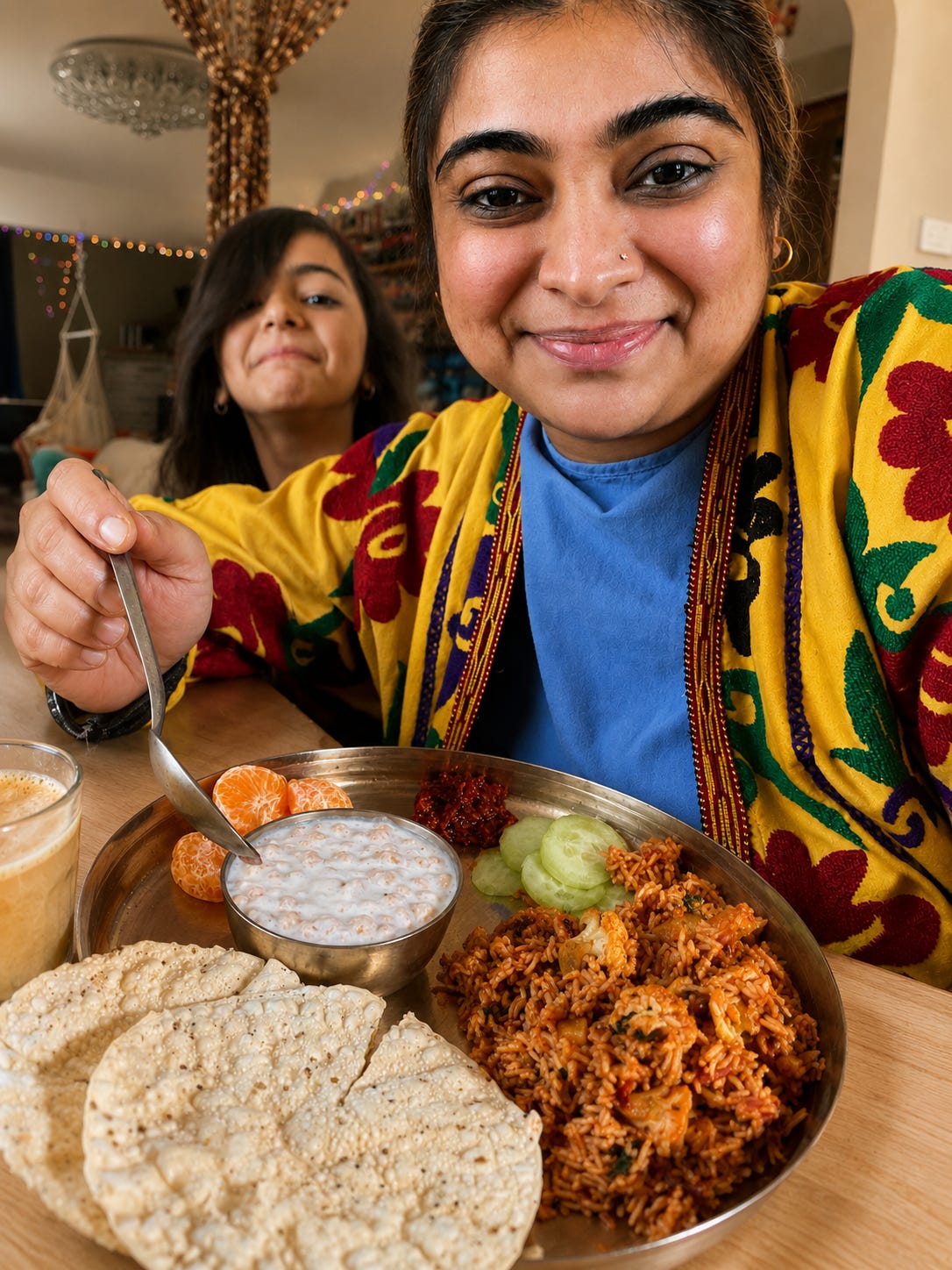
Bronze does not flirt.
It does not arrive light, cheap, cheerful, and ready to be added casually to the cart because one had a difficult afternoon and deserved a little treat.
No.
Good kansa bartan enters the kitchen with the calm financial seriousness of school fees, gold rates, and unexpected plumbing repairs. It is not for the faint of heart or, in this day and age, the faint of wallet.
Which is inconvenient, because I love it deeply.
More deeply, perhaps, than some of my actual noble metal jewellery. Jewellery comes out once in a blue moon, behaves beautifully for a few hours, receives compliments, and then returns to its box like a well-mannered guest.
Kansa does not live like that.
Kansa sits at the table. It receives food. It enters the rhythm of feeding. It does not merely adorn life. It participates in it.
And that, to me, is where the romance begins.
Not the easy romance of sparkle and compliment. The other kind. The slow kind. The kind where one must learn names, temperaments, boundaries, and the difference between what gleams honestly and what has merely been polished into confidence.
Naturally, my wallet has opinions.
It has been filing formal objections from the corner while muttering, “Bas, enough now.”
But the heart, as we know, is a terrible accountant.
The moment a vessel begins to participate in the household, it stops being an object and starts becoming inheritance.
This is how my courtship with kansa began.
Not with a grand ancestral trunk opening under dramatic light. Not with an elder placing a shining bronze plate in my hands and saying, “This belonged to your grandmother’s grandmother. Guard it with your life.”
No such convenient cinema was arranged for me.
My path to kansa was less elegant. It involved curiosity, suspicion, misplaced confidence, online listings, marketplace finds, shopkeepers with flexible definitions of truth, and my own former novice self being duped more than once in the sacred battlefield between pital and kansa.
Brass and bronze.
Cousins, yes.
Interchangeable, absolutely not.
But try telling that to a seller who has already decided you look emotionally available and insufficiently supervised.
In another life, perhaps an elder would have been beside me. Not necessarily a grand, shawl-draped, cinematic elder either. Sometimes all one needs is the practical kind, the one who knows metals, milkmen, mango seasons, pressure cooker gaskets, which shopkeeper exaggerates, and which cousin’s opinion should be respectfully ignored.
In the subcontinent, a household can feel incomplete without reliable help. Someone who knows where things are kept, what needs soaking, who came to the door, and why the gas cylinder man must not be trusted after lunch.
On foreign shores, a life can feel incomplete in another way, without that reliable elder wisdom nearby. Without someone to stand beside you, lift a vessel, tap its rim, hear its note, turn it toward the light, and say, “No, beta. This is pital. Leave it.” Or, “This one, yes. This is kansa. Feel the weight.”
Very useful, this kind of elder.
Tragically unavailable on most modern shopping platforms.
But geography, migration, and the frailty of life have their own arrangements. Some elders are far away. Some have become one with the ether. Some are no longer available to stand beside us in the marketplace and save us from our own enthusiasm.
And yet, I do not believe they vanish entirely.
Sometimes guidance arrives as instinct. Sometimes as hesitation. Sometimes as the benevolent ancestral whisper that says, “Beta, no. That shine is suspicious.”
So I learnt the modern way, by failing, comparing, asking questions, being fooled, and becoming slightly less easy to fool the next time.
Each piece of kansa I found felt less like shopping and more like excavation. Dug, discovered, chased, studied, doubted, claimed. A small archaeological expedition conducted by a woman with a phone, a budget, and entirely too much emotional investment in tableware.
But when the right piece came home, I knew.
Not always immediately, because bronze is not a cheap thrill. It reveals itself slowly. In the weight. In the muted glow. In the way food looks held by it. In the feeling that the table has suddenly remembered an older posture.
Kansa has the bearing of nobility, quiet, exacting, and entirely uninterested in being treated like common metal.
But nobility, at its best, should not terrify the household. It should raise the standard of behaviour a little.
This is where kalai, the old practice of tinning, enters. Not as a threat. Not as the moment everyone closes the essay and decides stainless steel has never looked more emotionally available.
Kalai belongs to the old world of common sense, where materials were not expected to be endlessly forgiving, and different vessels had different temperaments. This was not a problem. It was knowledge.
For those of us outside India, this can feel especially confusing. Is this kansa or pital? Is it lined? Is it unlined? Can I cook in it? Can I serve in it? Will lemon ruin it? Will tamarind start an argument? Has this seller told the truth, or merely arranged words attractively?
These are not foolish questions.
They are the beginning of relationship.
A stainless-steel bowl will usually accept almost anything you throw at it and ask very little in return. This is its great gift. Also, perhaps, its lack of personality.
Kansa is different.
It does not want to be feared, but it does expect to be understood. It asks us to learn the difference between serving and cooking, between lined and unlined, between what may be eaten promptly and what should not be left sitting as though bronze has volunteered for unpaid emotional labour.
Ancient metals are not closed doors.
They are old fort doors, heavy, carved, weathered by time, and not especially impressed by someone rattling the latch in a hurry. They do open, but they open on their own terms, slowly, beautifully, and with the deep satisfaction of entering a place that was never meant to be rushed.
Our elders knew this without turning lunch into a legal document. They knew which vessel could meet flame, which belonged on the table, which needed kalai, which should not be left with sour foods, and which deserved to be cleaned before some innocent person squeezed lemon into it with the confidence of modern ignorance.
There is always someone with confidence.
Confidence is not the same as knowledge.
Ask me how I know.
Kansa asks for respect, not fear.
And perhaps that is why bringing it home feels different from bringing home another pan, another bowl, another shiny object that promises ease. Kansa does not promise ease. It promises relationship. It asks you to pay attention, but it rewards that attention with something rare. A table that feels more awake, food that feels more received, and a meal that carries a little more dignity than the day may have deserved.
There is a reason bronze carries this kind of weight, not only in the hand, but in the imagination.
Human history has whole ages named after materials, which tells us something. We do not speak of the Plastic Age with reverence, though perhaps future archaeologists will have strong opinions and very depressing evidence.
Bronze is different.
Bronze belongs to that deep human moment when people discovered that two materials could come together and become something neither could be alone. Copper had its own beauty. Tin had its own usefulness. Together, they became bronze, harder, stronger, more enduring, capable of tools, bells, statues, vessels, ritual objects, and all the serious things human beings make when they are trying to survive, worship, cook, remember, and occasionally impress the neighbours.
Bronze changed what the hand could do.
And perhaps that is why kansa still feels different from other metals at the table. It carries, even quietly, that old lesson of joining.
Some strength is not solitary.
Some strength is alloyed.
How very kitchen.
How very marriage.
How very family.
How very risky, if no one has emotional maturity and everyone insists on remaining pure copper.
This is where bronze begins to move beyond utility for me. It is not only a vessel. It is a philosophy with a rim.
It says nothing here became strong alone.
Not the metal. Not the meal. Not the household. Not the person standing in the kitchen trying to decide whether this old bowl is truly kansa or whether one has once again been seduced by a seller with excellent lighting and no moral burden.
Old vessels are like that. They begin with lunch and end up interrogating your life choices.
Kansa keeps the table because it understands something old. A table is never just a flat surface where food lands. A table is where a household reveals itself. Who is served first. Who eats last. Who watches whether the child has eaten enough. Who insists they are not hungry and then takes from everyone else’s plate. Who pretends not to want the last piece and then looks betrayed when someone believes them.
Bronze belongs there.
Not because every meal must become ceremony. Heaven help us. Some meals are eaten standing, tired, distracted, and held together by leftovers and faith.
But even then, a good vessel can change the posture of a meal. It can ask us to sit a little straighter, notice what has been placed before us, and remember that food, after all its labour, deserves to be received well.
Iron works with fire.
Bronze works with presence.
Iron asks for attention at the stove.
Bronze asks for attention at the table.
And this is why I cannot think of kansa as decorative. Decoration stays outside the act. Kansa enters the act. It receives the dal, the sabzi, the roti, the rice, the ghee, the sweet, the offering. It holds food in a way that makes the meal feel less casual, even when the day itself has behaved with no dignity whatsoever.
There is comfort in that.
To eat from something old in spirit is to be reminded that we are not the first hungry people trying to make sense of a day. Many hands came before us. Many tables. Many meals. Many mistakes. Many vessels polished, neglected, rescued, misidentified, overpaid for, bargained over, inherited, lost, and found again.
Bronze holds all of that without becoming sentimental.
It simply gleams.
Quietly.
As if it has always known that the table is one of the oldest places where human beings try to become civilised.
And perhaps that is why I guard my kansa bartan with such unreasonable devotion.
Jewellery can stay in its box. Gold can behave itself in velvet. Silver can wait for weddings, festivals, and the occasional moment when one remembers one owns it. But kansa sits closer to life.
It is not waiting for special permission to matter.
A bronze bowl does not need a party. A kansa thali does not need a wedding invitation. Even when it is brought out with care, it carries the possibility of daily dignity.
That is what makes it precious to me.
Not precious in the locked-away sense. Not precious like something too delicate for human life. Precious because it asks to be used with attention. Because it turns feeding into receiving. Because it reminds me that the table, too, can have ancestry.
And no, I am not parting with mine.
Let the jewellery negotiate among itself. Let the occasional necklace wonder when its turn will come. My kansa has already claimed its place.
On the shelf, at the table, in the hand, near the food, near the life.
Clay remembered first.
Iron answered back.
Bronze keeps the table.
It teaches that not everything valuable must glitter loudly. Some things gleam quietly, hold steadily, and ask us to become worthy of what we receive.
And after bronze, another metal waits.
More brilliant. More temperamental. More seductive. More misunderstood.
Copper.
Of course.
Because no Indian kitchen would let us escape without one more complicated relationship.
As ever, thank you for your essay.
- "Ancient metals are not closed doors. They are old fort doors, heavy, carved, weathered by time, and not especially impressed by someone rattling the latch in a hurry."
So deliciously descriptive! Even auditory imagination is engaged.
- "This is where bronze begins to move beyond utility for me [...] It is a philosophy with a rim. It says nothing here became strong alone."
"Philosophy with a rim," amazing.
- "Some things gleam quietly [...] and ask us to become worthy of what we receive."
I understand precisely what you mean. Some caring, loyal people are like this too. <3